Trusted Execution Environments, Explained for AI Teams
AWS, Intel, AMD, and NVIDIA all ship a version of the secure enclave now, and they don't protect the same things. Here's what a trusted execution environment actually seals, why CPU-only isolation isn't enough for AI inference, and what to check before trusting a vendor's claim.
BSBrittany Seales· Marketing5 min read
On this page
If your AI team is deciding where sensitive inference workloads should run in 2026, the question has quietly shifted from whether you need a secure enclave to which one. AWS, Intel, AMD, and NVIDIA all ship a version of the technology now, and they protect meaningfully different things.
This is a landscape guide, not a buying pitch: what a secure enclave actually is, where CPU-only isolation stops being enough for AI workloads specifically, how to check a vendor's attestation claim rather than take it on faith, and who's already shipping production workloads on this in 2026, including SayGm.
Table of Contents
- What Is a Secure Enclave?
- The CPU Side: AWS Nitro, Intel TDX, and AMD SEV-SNP
- The GPU Problem: Why CPU Isolation Isn't Enough for AI
- How Remote Attestation Proves What's Actually Running
- What Should an AI Team Check Before Choosing One?
- Who's Actually Building on This in 2026
- Where SayGm Fits
- Final Thoughts on Choosing a Secure Enclave
What Is a Secure Enclave?
A secure enclave is a hardware-isolated region of a processor that keeps code and data shielded from everything else running on that machine, including whoever administers it. That's the mechanism behind a trusted execution environment, or TEE: the two terms describe the same idea from different angles, "secure enclave" naming the isolated space itself, "TEE" naming the broader guarantee it provides.
Encryption at rest and in transit have been standard for years. What a secure enclave adds is protection while data is actually being processed, closing the one window those two leave open: the moment data has to be decrypted to be computed on, whoever runs that machine can otherwise read it. The industry calls that gap data-in-use protection, and a secure enclave is the mechanism that closes it. Our deeper look at private inference covers the broader case for why that gap matters for AI workloads specifically, if you're weighing whether your team needs this at all before picking a platform.
The CPU Side: AWS Nitro, Intel TDX, and AMD SEV-SNP
Three of the most widely deployed secure enclave technologies work at the CPU level, and each takes a different approach to the same problem.
AWS Nitro Enclaves isolates vCPUs and memory from a parent EC2 instance using the Nitro Hypervisor, rather than a hardware TEE built into the chip itself. An enclave has no persistent storage, no interactive access, and no external networking of its own; it talks to its parent instance over a single constrained local channel, and it produces a signed attestation document a verifier can check against a known-good build. Nitro Enclaves work across Intel, AMD, and AWS's own Graviton processors, since the isolation comes from AWS's hypervisor layer rather than a specific chip vendor's silicon.
Intel TDX and AMD SEV-SNP take the opposite approach: the isolation is built into the processor itself, encrypting memory so even a compromised hypervisor or host OS can't read what's inside a protected virtual machine. Both produce a cryptographically signed measurement of exactly what's running, which is what a remote party checks during attestation, before deciding whether to trust the enclave with anything sensitive.
None of these three protects a GPU on its own. That's fine for workloads that never touch one, and a real gap for AI inference, which almost always does.
The GPU Problem: Why CPU Isolation Isn't Enough for AI
A CPU-only enclave still leaves model weights and inference data exposed the moment they cross onto a GPU, which is exactly where most of an AI workload's actual computation happens. Closing that gap needs the GPU itself to support confidential computing, not just the CPU coordinating it.
NVIDIA's Hopper (H100, H200) and Blackwell generations are currently the only GPUs that support this. NVIDIA's own documentation is specific about the setup: NVIDIA confidential computing on the GPU requires a CPU TEE running underneath it, either Intel TDX or AMD SEV-SNP, since the GPU's protection extends a chain of trust the CPU has to start. Older GPU generations, including the A100, have no equivalent at any price; there's no degraded or software-only fallback.
That combination, a CPU TEE paired with a confidential-capable GPU, is what actually closes the loop for AI inference specifically: the prompt, the model weights, and the GPU memory carrying both stay encrypted through the entire request, not just on the way in and out.
How Remote Attestation Proves What's Actually Running
A secure enclave is only as trustworthy as your ability to check it, and that check is called remote attestation. Before any sensitive data moves, the enclave produces a signed report describing exactly what code is running inside it. A client, or an independent verifier, compares that report against a known-good reference measurement, and decryption keys are only released once it matches.
This is what actually separates a checkable claim from a marketing one. Anyone evaluating a secure enclave vendor should be able to ask for that signed measurement and verify it, rather than reading a page that says "hardware-secured" and taking it as given.
What Should an AI Team Check Before Choosing One?
- CPU-only, or CPU plus GPU? If the workload runs inference on a GPU, and almost all AI workloads do, CPU isolation alone, like AWS Nitro Enclaves on their own, doesn't protect the model weights or the data once they reach it.
- Is the attestation actually client-verifiable? A signed measurement you can check yourself is a proof. A page that states the product "runs securely" without one is a policy claim wearing hardware language.
- What specifically is sealed, and from whom? A confidential VM can seal a host from its own operator while a model provider on the other end of a request still receives the prompt in the clear. Those are two different guarantees, and a vendor should be precise about which one you're getting.
- What's the performance and cost trade-off? Confidential-capable hardware is scarcer and costs more to rent than the generation below it, with a small performance overhead layered on top. That's a real cost against your infrastructure bill, even where the per-token price a developer pays doesn't necessarily go up.
Who's Actually Building on This in 2026
This moved from research curiosity to production infrastructure decision faster than most confidential computing predictions expected. Anthropic and Irregular published a joint whitepaper on confidential AI inference systems this year, laying out how TEEs let a model owner, a data owner, and a cloud provider all get what they need from one inference request without any of them having to trust the others directly. Separately, Sigma Software and NEAR AI announced a partnership to deploy NEAR AI's confidential computing stack into enterprise environments, starting with financial-services pilots, specifically because prompts and outputs need to stay encrypted through computation, not just in transit.
Neither of those is a fringe research demo. Both are evidence that secure enclaves are becoming a standard line item in how serious AI infrastructure gets built, not an exotic option reserved for the most paranoid teams.
Where SayGm Fits
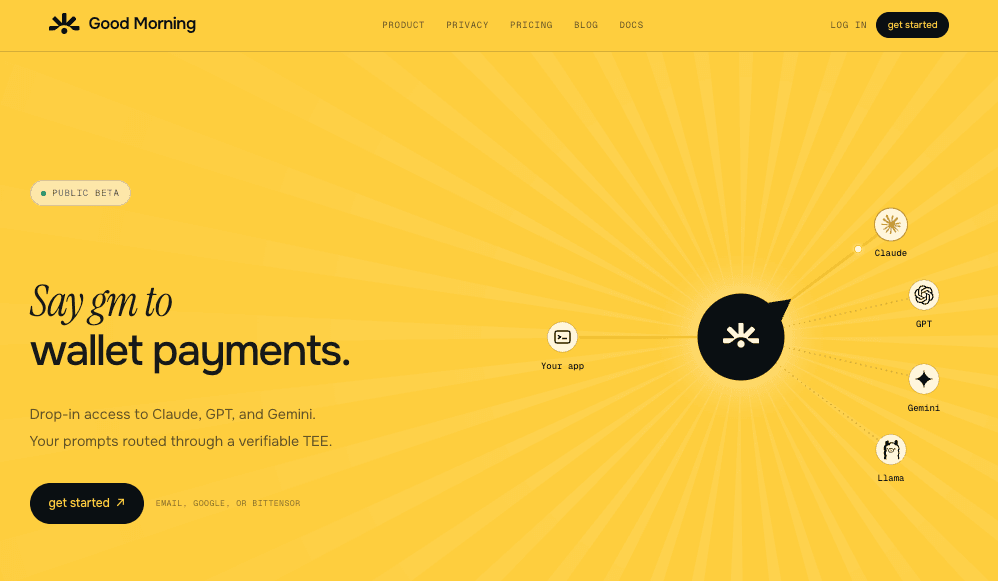
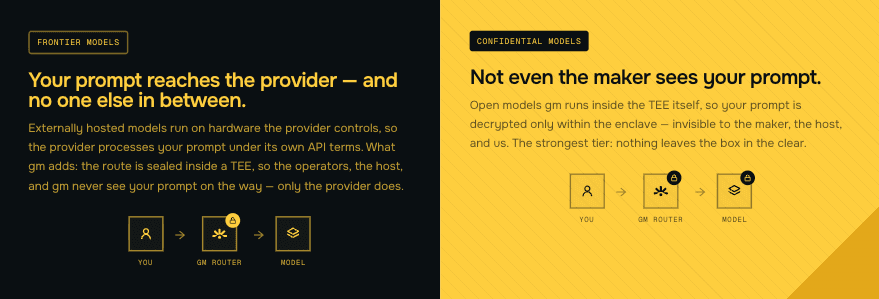
SayGm runs its gateway inside an Intel TDX confidential VM, and for open-weight models, inference runs inside the enclave itself, so the prompt is invisible to the model maker, the host, and SayGm alike. Frontier models like Claude, GPT, and Gemini route through the same sealed enclave, though the model maker on the other end still receives the prompt content under its own terms, the same as it would calling that provider directly. Both guarantees sit on one catalog and one OpenAI-compatible endpoint, so trying either is a base URL and a key, not a rewrite. The quickstart guide gets you to a first request in a few minutes, and our deeper look at private inference covers the buyer-side case for when this matters for your workload.
Final Thoughts on Choosing a Secure Enclave
CPU-only isolation, like AWS Nitro Enclaves, is a real technology with real uses, but it isn't the whole answer for AI inference on its own. The workloads that actually need protecting run on a GPU, which means the secure enclave question for an AI team really has two parts: is the CPU sealed, and is the GPU sealed too, with a client-checkable attestation tying both together. Get a clear answer to both before committing infrastructure spend to any one vendor's claim.
About SayGm
SayGm is a drop-in inference gateway for teams who don't want to just take a company's word that their prompts are private. Every request runs inside a hardware-verified confidential environment - not even SayGm can see what's inside it. That's not a policy, it's provable. Swap in your existing OpenAI, Anthropic, or Gemini code and you're covered in minutes, at transparent, published rates with no hidden markup.
Say gm to AI at saygm.com.
- Inference
- TEE
BS