Claude Code Pricing 2026: Plans, API Costs and Rate Limits
Claude Code comes with every paid Claude plan from $20 a month, or you can pay per token with an API key. Here's what Pro, Max, Ultra, Team and API billing cost in a real month, how the limits work, and when a subscription beats per-token billing.
DDaniel· Builder5 min read
On this page
Prices checked 5 November 2026. Claude Code isn't sold on its own: it comes with every paid Claude plan, from Pro at $20 a month ($17 a month billed annually), or you pay per token through an API key. For light use, a few sessions a week, per-token billing on SayGM works out at about $5 to $11 a month, below Pro. For regular daily use, Max at $100 is the simple choice if your work fits its limits; on SayGM the same month costs about $32 on Sonnet 5.5 or $64 on Opus 5.5. For heavy all-day use on Opus, Ultra at $200 is cheaper than per-token billing on Anthropic's API or SayGM, as long as you stay inside its weekly limit. Per token, SayGM is 48.5% below Anthropic's API on every Claude model, including cache reads and writes.
Claude Code pricing, checked 5 November 2026
| Option | How you pay | Price | Usage limit | Models | Best for | Checked |
|---|---|---|---|---|---|---|
| SayGM pay-as-you-go | Prepaid credit, per token | Opus 5.5 $2.06 in / $10.30 out per 1M tokens; Sonnet 5.5 $1.03 / $5.15 | No plan limit; prepaid balance | 11 Claude models, Fable 5.1 to Haiku 4.5 | Light and variable use, teams on one key | 5 Nov 2026 |
| Anthropic API | Console credit, per token | Opus 5.5 $4 / $20 per 1M tokens; Sonnet 5.5 $2 / $10 | Rate limits by tier, from 4,000 requests a minute on Start | All current Claude models | Builders who want Anthropic's own account and terms | 5 Nov 2026 |
| Claude Pro | Subscription | $20 a month, or $17 a month billed annually | Rolling 5-hour limit plus a weekly limit | Opus, Sonnet, Haiku; Fable with usage credits | Light to moderate use alongside chat | 5 Nov 2026 |
| Claude Max | Subscription | $100 a month | 5x Pro, every 5 hours and every week | Adds Fable, up to half the weekly limit | Daily coding | 5 Nov 2026 |
| Claude Ultra | Subscription | $200 a month | 10x Pro every week; no 5-hour limit on verified accounts | Same as Max | All-day coding on Opus | 5 Nov 2026 |
| Team, Standard seat | Per seat | $25 a month, or $20 billed annually | More than Pro | Opus, Sonnet, Haiku | Teams of 2 to 150 | 5 Nov 2026 |
| Team, Premium seat | Per seat | $125 a month, or $100 billed annually | 5x a Standard seat | Adds Fable, up to half the weekly limit | Heavy users inside a team | 5 Nov 2026 |
Method: plan prices and limits from Anthropic's pricing page and its Claude Code support article; API rates from Anthropic's pricing docs; SayGM rates from the live catalog and Claude models page, all checked 5 November 2026. Prices exclude tax.
Table of Contents
- How much does Claude Code cost?
- Claude Code plans compared
- What Claude Code costs on API billing
- What a month of Claude Code really costs
- Claude Code limits explained
- What to do when you hit a limit
- How to spend less on Claude Code
- Claude Code pricing FAQ
- TL;DR
- About SayGM
How much does Claude Code cost?
As of 5 November 2026, Claude Code costs $20 a month at the cheapest, on Claude Pro, or nothing up front if you pay per token with an API key. There's no separate Claude Code price. You pay for Claude, and Claude Code is one of the ways you use it.
The two ways to pay behave very differently.
A subscription is a flat monthly fee with a usage limit. Claude Code, the Claude apps and Claude in your IDE all draw from the same pool, which refills on a rolling five-hour window and a weekly window. You never see a per-token bill, but you can run out mid-task.
Per-token billing has no plan limit and no flat fee. Every request is charged for the tokens it reads and writes, at the model's rate. You can't run out of plan, but a long Opus session can cost more than you expect, because Claude Code resends your codebase context on every turn.
Anthropic's own figures give a sense of scale. Across enterprise deployments, it reports an average of about $13 per developer per active day and $150 to $250 per developer per month at API rates, with 90% of users under $30 a day, per its Claude Code costs docs. At SayGM's rates, that $150 to $250 month would be about $77 to $129.
Claude Code plans compared
Every paid plan includes Claude Code. The free Claude plan doesn't: Anthropic's setup docs say Claude Code needs a Pro, Max, Team, Enterprise or Console account.
Pro
$20 a month, or $200 a year ($17 a month). Pro has a rolling five-hour limit and a weekly limit, shared between Claude Code and chat. It includes Opus, Sonnet and Haiku. Anthropic's top model, Fable, is only available on Pro through usage credits at API rates. Pro suits someone who codes with Claude a few times a week, or daily on small tasks.
Max
$100 a month, billed monthly. Max gives 5x Pro's usage every five hours and every week, adds Fable for up to half your weekly limit, and gives priority access at busy times. It also includes $100 a month in API credits for the Claude Platform, but Anthropic's support article says those credits can't be used in Claude Code or the Claude apps. Max suits a developer who uses Claude Code most working days.
Ultra
$200 a month, billed monthly. Ultra gives 10x Pro's weekly usage, and verified accounts have no five-hour limit, so a long session won't stall mid-afternoon. It includes Fable on the same terms as Max and $200 a month in API credits, again not usable in Claude Code. Ultra suits all-day coding, especially on Opus.
Team and Enterprise
Team is for 2 to 150 people. A Standard seat is $25 a month, or $20 billed annually, with more usage than Pro. A Premium seat is $125 a month, or $100 billed annually, with 5x a Standard seat's usage and Fable for up to half the weekly limit. Claude Code is listed on both seat types, and you can mix them. Team adds SSO, central billing and no model training on your content by default.
Enterprise is $20 per seat per month, billed annually with a 20-seat minimum, plus usage at API rates. It adds SCIM, audit logs, custom data retention, role-based access and spend limits set by admins. For a team whose use varies a lot between people, Enterprise moves the cost closer to per-token billing.
What Claude Code costs on API billing
On API billing, Claude Code is charged at the model's per-token rates. Four kinds of token matter: fresh input, cache writes (context stored for reuse), cache reads (stored context read back) and output. Claude Code leans hard on the cache, so cache rates shape the bill more than the headline input price does.
Claude API rates for Claude Code, per 1M tokens, checked 5 November 2026
| Model | Where | Input | Cache write (5 min) | Cache read | Output |
|---|---|---|---|---|---|
| Claude Opus 5.5 | SayGM | $2.06 | $2.575 | $0.103 | $10.30 |
| Claude Opus 5.5 | Anthropic | $4.00 | $5.00 | $0.20 | $20.00 |
| Claude Sonnet 5.5 | SayGM | $1.03 | $1.2875 | $0.0515 | $5.15 |
| Claude Sonnet 5.5 | Anthropic | $2.00 | $2.50 | $0.10 | $10.00 |
| Claude Haiku 5.5 | SayGM | $0.0515 | $0.0644 | $0.0052 | $0.2575 |
| Claude Haiku 5.5 | Anthropic | $0.10 | $0.125 | $0.01 | $0.50 |
| Claude Fable 5.1 | SayGM | $5.15 | $6.4375 | $0.1288 | $25.75 |
| Claude Fable 5.1 | Anthropic | $10.00 | $12.50 | $0.25 | $50.00 |
Haiku 5.5 rates are for prompts up to 100,000 tokens; above that, both Anthropic and SayGM charge five times as much. Opus 5.5 and Sonnet 5.5 keep the same rate across their full 1M-token context. Anthropic's Batch API is 50% off, but Claude Code is interactive, so batch pricing doesn't apply to it. The full list, including older models, is on SayGM's Claude models page and in SayGM vs Anthropic.
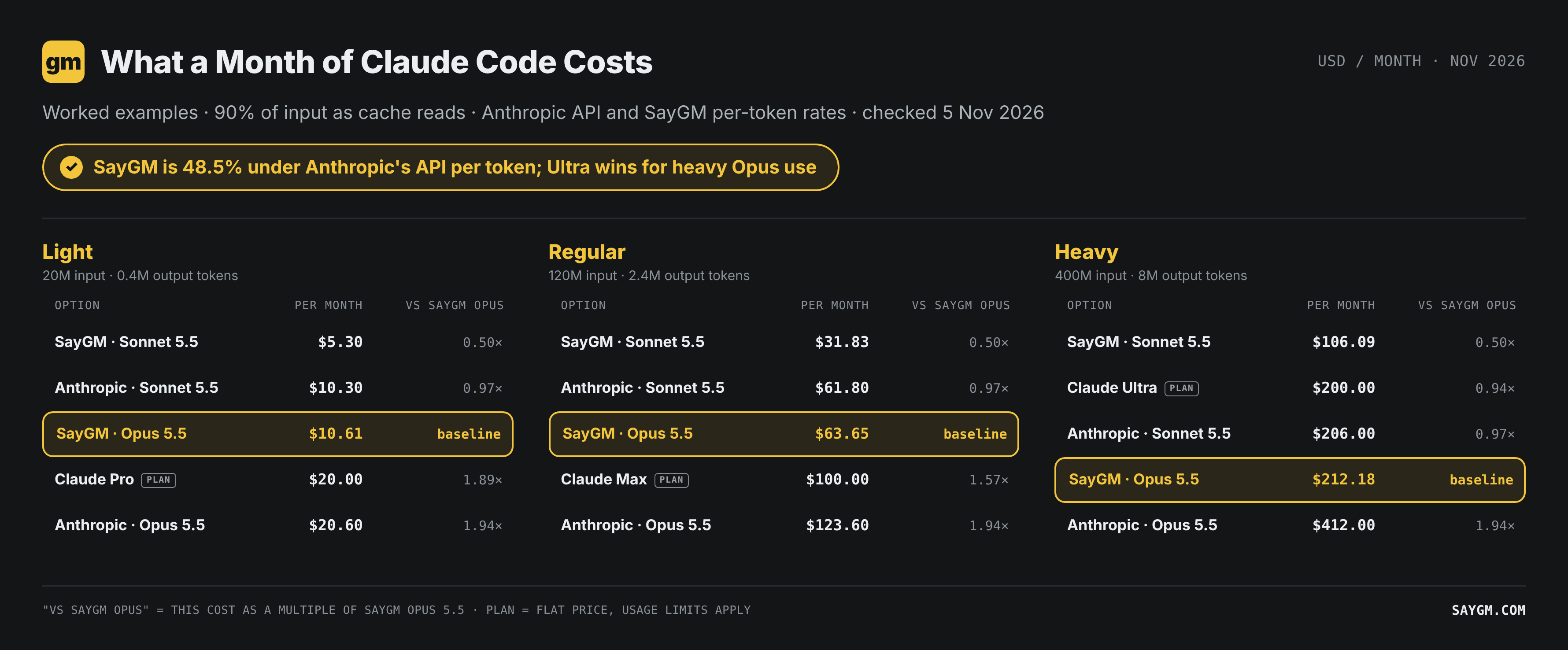
What a month of Claude Code really costs
These are worked examples, with the token volumes stated so you can scale them to your own use. Each assumes 90% of input tokens are cache reads, 5% cache writes and 5% fresh input. That split is our assumption for an agent resending the same codebase context each turn; /usage in Claude Code shows your own cache hit rate. Input here means every token Claude Code sends, including the context it resends.
- Light: a few sessions a week. 20M input tokens and 0.4M output tokens a month.
- Regular: most working days. 120M input and 2.4M output a month.
- Heavy: all day, every day. 400M input and 8M output a month.
Monthly Claude Code cost by usage level, checked 5 November 2026
| Usage | Anthropic API, Opus 5.5 | SayGM, Opus 5.5 | Anthropic API, Sonnet 5.5 | SayGM, Sonnet 5.5 | Nearest subscription |
|---|---|---|---|---|---|
| Light | $20.60 | $10.61 | $10.30 | $5.30 | Pro, $20 |
| Regular | $123.60 | $63.65 | $61.80 | $31.83 | Max, $100 |
| Heavy | $412.00 | $212.18 | $206.00 | $106.09 | Ultra, $200 |
The comparison with a subscription comes down to one question that Anthropic doesn't answer in numbers: how much work fits inside each plan's limit. Anthropic says the limit depends on the model, the length of your conversations and the size of your files, and it doesn't publish a token allowance. So the break-even below assumes your month fits inside the plan.
- Pro at $20 beats Anthropic's API at about the light example on Opus. Against SayGM, Pro only pays off at around twice the light example on Opus, or four times on Sonnet.
- Max at $100 beats Anthropic's API at about 0.8 times the regular example on Opus, or 1.6 times on Sonnet. Against SayGM, Max pays off at about 1.6 times the regular example on Opus, or three times on Sonnet.
- Ultra at $200 is a little cheaper than the heavy Opus month even at SayGM's rates, and half the Anthropic API cost. For heavy, steady Opus use that fits inside Ultra's weekly limit, the subscription is the cheapest way to pay.
Per-token billing wins when your use is uneven: quiet weeks cost almost nothing, and a busy week can't hit a plan limit. A subscription wins when you use Claude Code steadily and heavily, and when you also use Claude chat, which shares the same plan.
Claude Code limits explained
As of 5 November 2026, Pro and Max have a rolling five-hour session limit and a weekly limit, while Ultra has only a weekly limit on verified accounts, and all three share those limits between Claude Code and the Claude apps.
Subscription limits. The five-hour limit runs on a rolling window, and the weekly limit sits on top. Max and Ultra also have a separate weekly limit for Fable. Anthropic doesn't give a fixed number of messages or tokens, because a long Opus conversation over a big repository uses far more than a short Haiku one. It also says it may limit use in other ways, such as monthly caps or limits on certain models and features, to keep access fair. You can see where you stand in Settings > Usage, or with /status in Claude Code.
API rate limits. On the Anthropic API, limits come from your organisation's usage tier, which Anthropic sets automatically from your usage history and account standing:
| Tier | Monthly spend cap | Opus 5.5 and Sonnet 5.5 limits |
|---|---|---|
| Start | $500 | 4,000 requests, 2M input tokens and 400K output tokens a minute |
| Build | $1,000 | 10,000 requests, 5M input tokens and 1M output tokens a minute |
| Scale | $200,000 | 13,000 requests, 10M input tokens and 2M output tokens a minute |
| Custom | No cap | Agreed with Anthropic |
Cache reads don't count toward the input-token limit on current Claude models, which matters for Claude Code because most of its input is cache reads. New organisations may start on a lower evaluation tier. For teams, Anthropic's Claude Code docs suggest planning around 200,000 to 300,000 tokens a minute per user for one to five users, falling to 10,000 to 15,000 per user at 500 or more.
On SayGM, requests are routed across providers. If one route is rate-limited, the gateway retries on another route within the request's time budget, and returns HTTP 429 with a Retry-After header only when every matching route is limited, per SayGM's error docs.
What to do when you hit a limit
As of 5 November 2026, when you hit a Claude Code limit on a paid plan, you can wait for the window to reset, move to a higher plan, or turn on usage credits to keep working at standard API rates. If a response is in progress when the five-hour limit lands, Claude Code may finish the current step and shows "Usage limit reached · wrapping up". Anthropic says that allowance is small and capped, counts toward your weekly limit, applies up to once a week on Pro, and is still rolling out.
Your options, in rough order of cost:
- Wait. The five-hour window rolls, so a short break often frees enough. The weekly limit takes longer.
- Change model, but only after a model-specific limit. Session and weekly limits are shared across models, so
/modelwon't restore access once you've hit them. It helps only after a message such as "You've hit your Opus limit", when a model outside that family keeps you working. Switching mid-session also means the next request rereads the whole conversation without the cache. - Upgrade. Pro to Max is 5x the usage for five times the price, and Max to Ultra removes the five-hour limit on verified accounts.
- Switch to per-token billing. Usage credits on your plan bill at Anthropic's API rates. A Console API key does the same outside the plan. Or point Claude Code at a gateway and pay a lower per-token rate: you can use Claude Code with SayGM at 48.5% below Anthropic's API rates.
If you have ANTHROPIC_API_KEY set and approve it, Claude Code uses that key instead of your subscription, and charges per token. Run /status to see which one is active.
How to spend less on Claude Code
The biggest savings come from model choice and context size.
- Default to Sonnet. Sonnet 5.5 costs half as much as Opus 5.5 per token, and Anthropic's docs say it handles most coding tasks well. Keep Opus for hard debugging and long refactors. Pick the model at the start of a session, because switching mid-session rereads the history without the cache.
- Send simple subagent work to Haiku. Anthropic's docs suggest
model: haikufor simple subagents. Haiku 5.5 is a twentieth of Sonnet's price for prompts up to 100,000 tokens. - Keep the cache warm. Cache reads cost a twentieth of fresh input on Opus 5.5 and Sonnet 5.5. On an API key, the cache lasts five minutes by default, so long gaps mean paying for cache writes again. You can set
promptCacheTtlto1h, which costs more per cache write. On a subscription, the main conversation gets a one-hour cache within your plan's included usage. SayGM keeps a conversation on the same provider where it can, per its routing docs, so the cache keeps working. - Clear between tasks.
/clearbetween unrelated tasks stops Claude Code resending a finished task's context. - Lower the effort. You can't turn thinking off on Opus 5.5, Sonnet 5.5 or Haiku 5.5, but
/effortreduces how much the model thinks, which cuts output tokens. - Skip fast mode unless you need it. Fast mode on Opus 5.5 costs twice the standard rate.
- Watch the meter.
/usageshows a session's total cost, worked out at Anthropic's list price. On SayGM your real spend is about half that figure, so check the SayGM dashboard for what you actually paid.
Claude Code pricing FAQ
How much is Claude Code?
As of 5 November 2026, Claude Code costs $20 a month on Claude Pro ($17 a month billed annually), $100 on Max or $200 on Ultra, or you pay per token with an API key. On per-token billing, Opus 5.5 is $4 per million input tokens and $20 output on Anthropic's API, and $2.06 and $10.30 on SayGM.
Is Claude Code free?
No. As of November 2026, Claude Code isn't included in the free Claude plan; it needs a Pro, Max, Team, Enterprise or Console account. The Claude Code tool itself costs nothing to install, so on per-token billing you pay only for the tokens you use.
Is there a Claude Code trial?
Anthropic doesn't list a free trial for individual plans as of November 2026. Its pricing page lists trials only for sales-assisted Enterprise. The cheapest way to try Claude Code is a month of Pro at $20, or a small amount of per-token credit.
Is Claude Code included in Claude Pro?
Yes. As of November 2026, Claude Code is included in Pro and every other paid plan, and it shares the plan's five-hour and weekly limits with Claude chat.
Is Max worth it for Claude Code?
As of November 2026, Max at $100 a month is worth it if you use Claude Code most working days and your work fits inside its limits, because the same month at Anthropic's API rates can cost more than $120 on Opus 5.5. If your use is uneven, per-token billing can cost less: about $64 for that regular month on Opus 5.5 through SayGM, or $32 on Sonnet 5.5.
What are the Claude Code rate limits?
On a subscription, Claude Code has a rolling five-hour limit and a weekly limit, shared with the Claude apps, as of November 2026; Ultra drops the five-hour limit on verified accounts. On the Anthropic API, limits depend on your tier, starting at 4,000 requests and 2 million input tokens a minute for Opus 5.5 on the Start tier, with a $500 monthly spend cap.
Can I use Claude Code with an API key?
Yes. Set ANTHROPIC_API_KEY and approve it when Claude Code asks, and it bills per token instead of using your subscription. You can use a key from the Anthropic Console, or a gateway key: to use Claude Code with SayGM, set ANTHROPIC_BASE_URL to SayGM and use a SayGM key.
Which model should I use in Claude Code?
As of November 2026, Sonnet 5.5 is the best default for most coding at $2 per million input tokens and $10 output on Anthropic's API. Use Opus 5.5 at $4 and $20 for hard problems, and Haiku 5.5 for simple subagent work. Fable 5.1, Anthropic's top model, costs $10 and $50 and counts against a separate weekly limit on Max and Ultra.
TL;DR
Claude Code comes with every paid Claude plan, from Pro at $20 a month, or you pay per token with an API key. Light and uneven users pay least per token: about $5 to $11 a month on SayGM, 48.5% below Anthropic's API. Steady daily users do well on Max at $100, and heavy all-day Opus users on Ultra at $200, as long as their work fits the plan limits.
On SayGM, Claude requests pass through a gateway sealed in an Intel TDX enclave that its operators can't read, but Anthropic still receives and processes the prompt under its API terms. For what that means in practice, see is Claude private. For open-weight models priced even lower, see the cheapest LLM API.
About SayGM
SayGM is a drop-in inference gateway for teams who don't want to just take a company's word that their prompts are private. Route to a confidential model and your prompt is sealed inside hardware-verified execution, where not even SayGM can see it. That's not a policy, it's provable. Swap in your existing OpenAI, Anthropic, or Gemini code and you're covered in minutes, at transparent, published rates with no hidden markup.
Say gm to AI at saygm.com.
- Claude
- Pricing
D
DanielBuilder
Helping to build and grow SayGM. Obsessed with technology & AI, especially local, private models, and TinyML