OpenRouter Privacy: Hardware Attestation vs a Privacy Policy
If you're evaluating openrouter alternatives, the usual sticking points are the platform fee, the model catalog, or a security question "we don't log your prompts by default" doesn't quite answer. Here's how SayGm's hardware-attested TEE actually stacks up against OpenRouter's policy-based privacy, model for model and dollar for dollar.
BSBrittany Seales· Marketing5 min read
On this page
If you're checking out openrouter alternatives, the reason is usually one of three things: the credit-purchase fee, the size of the model catalog, or a question your security team asked that "OpenRouter doesn't log your prompts by default" doesn't fully answer. SayGm is built around that third one. Here's how the two actually compare.
Table of Contents
- What OpenRouter Actually Does With Your Prompts
- What "Hardware Attestation" Means, Concretely
- SayGm vs OpenRouter: Privacy Model Compared
- SayGm vs OpenRouter: Pricing Compared
- Model Catalog and Drop-In Compatibility
- Which One Should You Actually Use?
- Frequently Asked Questions
What OpenRouter Actually Does With Your Prompts
OpenRouter's own documentation is fairly direct about this, which is worth giving them credit for: by default, OpenRouter does not store your prompts or completions, only request metadata like token counts and latency. You can opt into prompt logging for debugging, and there's a separate opt-in that lets OpenRouter use your prompt data to improve the product in exchange for a 1% usage discount. Zero Data Retention is available too, enforceable per-request if you pass a zdr parameter.
None of that is a small thing. But look at what it actually rests on: a setting. A policy. A promise from OpenRouter, and separately, a promise from whichever underlying provider (OpenAI, Anthropic, Google, or dozens of others) your request happens to route to that day. If OpenRouter's policy changes, or a provider's data retention terms differ from what's advertised, there's no way for you to independently check that your specific prompt was actually handled the way the docs say it would be. You're trusting the paperwork - prompt privacy that depends on a setting staying set, not on anything structurally enforced.
What "Hardware Attestation" Means, Concretely
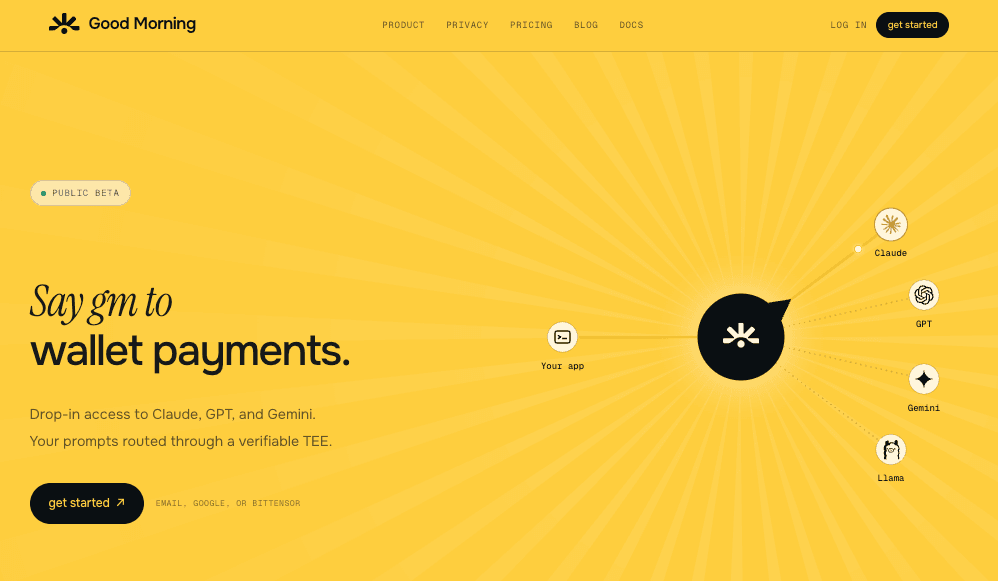
SayGm runs its gateway inside an Intel TDX confidential virtual machine: a secure enclave carved out of the processor itself, sealed off from the host operating system and the hypervisor. This is the missing piece confidential computing exists to solve: data is normally exposed while it's being processed, and a trusted execution environment closes that gap.
The part that actually matters for a privacy claim is remote attestation: before your request is trusted, the chip itself produces a signed measurement of exactly what code is running inside the enclave. You (or your security team, or an auditor) can check that measurement against a known-good build, independent of anything SayGm says about itself. That's the structural difference. A policy is something a company tells you. Attestation is something the hardware proves, and you can verify it yourself rather than take it on faith.
Worth being precise here, because "SayGm can't read it" isn't one guarantee, it's two, and they don't cover the same ground:
- Frontier models (Claude, GPT, Gemini): identity-blind, anonymous routing. The model maker still receives the prompt content, same as it would through any gateway.
- Open-weight models: full TEE inference. The prompt is invisible to the model provider, the host, and SayGm, not just anonymized before being forwarded.
Blurring those into one blanket "nobody can read your prompt" claim is the kind of overstatement this category needs less of, not more.
SayGm vs OpenRouter: Privacy Model Compared
| SayGm | OpenRouter | |
|---|---|---|
| Privacy basis | Hardware attestation (Intel TDX) | Policy and opt-in settings |
| Can you independently verify it? | Yes, via the signed attestation measurement | No, you're relying on stated terms |
| Open-weight models | Prompt invisible to provider, host, and SayGm | Visible to whichever provider serves the request |
| Frontier models (Claude, GPT, Gemini) | Anonymous, identity-blind routing; provider still sees prompt content | Provider sees prompt content; retention depends on provider policy |
| Data retention control | Structural (nothing to retain in the confidential tier) | Configurable opt-in/opt-out per account and per request |
OpenRouter's settings are genuinely useful controls, and Zero Data Retention is a real, meaningful option for teams who need it. The distinction isn't that one cares about privacy and the other doesn't. It's that one guarantee can be checked against silicon, and the other can't be checked against anything but a terms page.
SayGm vs OpenRouter: Pricing Compared
Model inference itself is priced without markup on both platforms, so the real difference shows up in the fees layered on top. Per OpenRouter's own FAQ, funding an account carries a 5.5% fee (with an $0.80 minimum) on card and Stripe purchases, 5% on crypto purchases, and a 5% fee on Bring Your Own Key usage past $25,000 in monthly list-price inference cost on the Pay-as-you-go plan ($200,000 on Enterprise).
SayGm runs on prepaid credit with no subscription and no comparable purchase fee. Frontier models are priced at or below what the model maker itself charges, and the confidential (open-weight, TEE) tier tends to run cheaper still, which means the most private tier is also typically the cheapest one rather than a premium add-on. Every rate is published in a machine-readable catalog (GET /v1/models) rather than sitting on a static pricing page, so it's checkable the same way the attestation claim is.
To see what you'd save on your own volumes, run the numbers on the SayGm vs OpenRouter comparison page.
Exact percentage-point differences move as SayGm's miner competition and OpenRouter's own fee schedule both shift, so pull the current numbers from saygm.com/#pricing or OpenRouter's FAQ before quoting a specific figure to a customer or in a proposal. If you're specifically weighing OpenRouter's free-tier models against a cheap paid alternative, we've broken that comparison down separately.
Model Catalog and Drop-In Compatibility
OpenRouter's biggest, most defensible advantage is breadth: 300+ models across 60+ providers, including long-tail models that show up on exactly one provider's catalog the week they launch. SayGm's catalog runs smaller, currently 51 models spanning Claude, GPT, Gemini, DeepSeek, Kimi, Qwen, and Mistral, chosen for coverage of the frontier and open-weight models teams actually route production traffic to rather than chasing every new release.
On integration, the two are close to interchangeable: both support OpenAI-compatible Chat Completions, so switching between them (or running both) is a base URL and API key change, not a rewrite. SayGm's quickstart guide walks through the swap for Claude Code, Cursor, and other tools you're likely already using.
Which One Should You Actually Use?
If your workload genuinely needs a long-tail model that only exists on one obscure provider, or you're not the one deciding how prompts get handled once they leave your app, OpenRouter's catalog breadth is the practical answer. If the prompt itself is the sensitive part, patient data, contract terms, unreleased source code, and "we have a policy" isn't going to satisfy the security review you're facing, SayGm's attestation model is built for exactly that conversation.
Frequently Asked Questions
Is OpenRouter's Zero Data Retention setting the same as attestation?
No. ZDR is a policy setting OpenRouter and its providers agree to honor; it changes what gets logged, not what's technically possible to log. Attestation is a hardware-level proof of what code is running, checkable independently of any policy.
Does SayGm see my prompts on frontier models like Claude or GPT?
No, but the model maker does. SayGm's frontier routing is anonymous and identity-blind: your identity, account, and IP are stripped before the request reaches the provider, so the prompt is anonymized even though its content isn't sealed from the model maker the way it is on the open-weight, TEE tier. That's still a real difference from a typical gateway, where your usage stays linked to your account.
Can I switch from OpenRouter to SayGm without rewriting my app?
For standard OpenAI-compatible Chat Completions calls, yes. It's a base URL and API key swap. Provider-specific or enhanced endpoints outside the standard interface may need small adjustments.
About SayGm
SayGm is a drop-in inference gateway for teams who don't want to just take a company's word that their prompts are private. Every request runs inside a hardware-verified confidential environment - not even SayGm can see what's inside it. That's not a policy, it's provable. Swap in your existing OpenAI, Anthropic, or Gemini code and you're covered in minutes, at transparent, published rates with no hidden markup.
Say gm to AI at saygm.com.
- Gateway
- LLM
- OpenRouter
- Privacy
BS