Top 5 OpenRouter Alternatives (With Real Pricing)
OpenRouter earned its spot as the default multi-model gateway, but its 5.5% platform fee and policy-based privacy model have left room for real competition. This breakdown compares five alternatives, including SayGm's TEE-verified routing, with real, current pricing for each.
BSBrittany Seales· Marketing5 min read
On this page
Last updated 30 September 2026. Pricing and catalog figures re-checked against each provider's live pages.
SayGm's model catalog currently runs about 33% below published retail on average across 62 live models, with no subscription and no credit-purchase fee, because providers compete to serve each request. That's a useful starting point for anyone comparing OpenRouter alternatives in 2026, since it shows what's changed in this category: gateways now compete on price transparency and on what "private" really means, as well as catalog size.
OpenRouter is still the default a lot of developers reach for first, and it earned that with a 500+ model catalog and a fast integration path. But its 5.5% fee on card credit purchases (5% on crypto) and a privacy model built on policy rather than hardware have opened the door for alternatives. Below are five worth putting next to OpenRouter, what each one costs, and where each one is the better fit.
Table of Contents
- OpenRouter Alternatives Compared at a Glance
- What Makes a Real OpenRouter Alternative in 2026?
- Top 5 OpenRouter Alternatives
- How OpenRouter's Own Pricing Compares
- Which Alternative Should You Pick?
- Common Questions about OpenRouter Alternatives
- Final Thoughts
OpenRouter Alternatives Compared at a Glance
| Gateway | Pricing Model | Model Catalog | Privacy Approach | Best For |
|---|---|---|---|---|
| SayGm | No subscription, no credit fee; ~33% below published retail on average | 62 models | Hardware-verified TEE for open-weight models; anonymous routing for frontier models | OpenRouter-level convenience with verifiable privacy and no platform fee |
| OpenRouter | 5.5% fee on card credit purchases ($0.80 minimum), 5% via crypto; no per-token markup | 500+ models | Policy-based; terms vary by provider, no attestation | Broadest catalog and fastest setup for prototyping |
| Cheaper Inference | Usage-based, 30-50% off list on listed models; $5 minimum deposit | 72 models, including image, video and audio | Policy-based; billing metadata only, zero retention on supported routes | A broad discounted catalog including media models |
| DeepInfra | Pay per token; Priority at 1.5x, Flex at 0.8x | 100+ models, including Claude and Gemini | Policy-based; no storage or training without consent | Open-weight models at volume from an established host |
| Together AI | Pay per token, no subscription; discounted batch rates | 200+ models across text, image, video and audio | Policy-based; no training without opt-in, zero data retention available | Open-weight models plus fine-tuning and dedicated capacity in one place |
| Requesty | 5% markup on provider rates; free tier at 200 requests/day | 600+ models | Policy-based; EU data residency on every plan | Lightest managed drop-in swap for OpenRouter |
Pricing and catalog figures checked 30 September 2026 and change often; check each provider's live pricing page before making a decision. See SayGm's live model catalog and pricing.
Real Pricing: Three Models on Every Provider
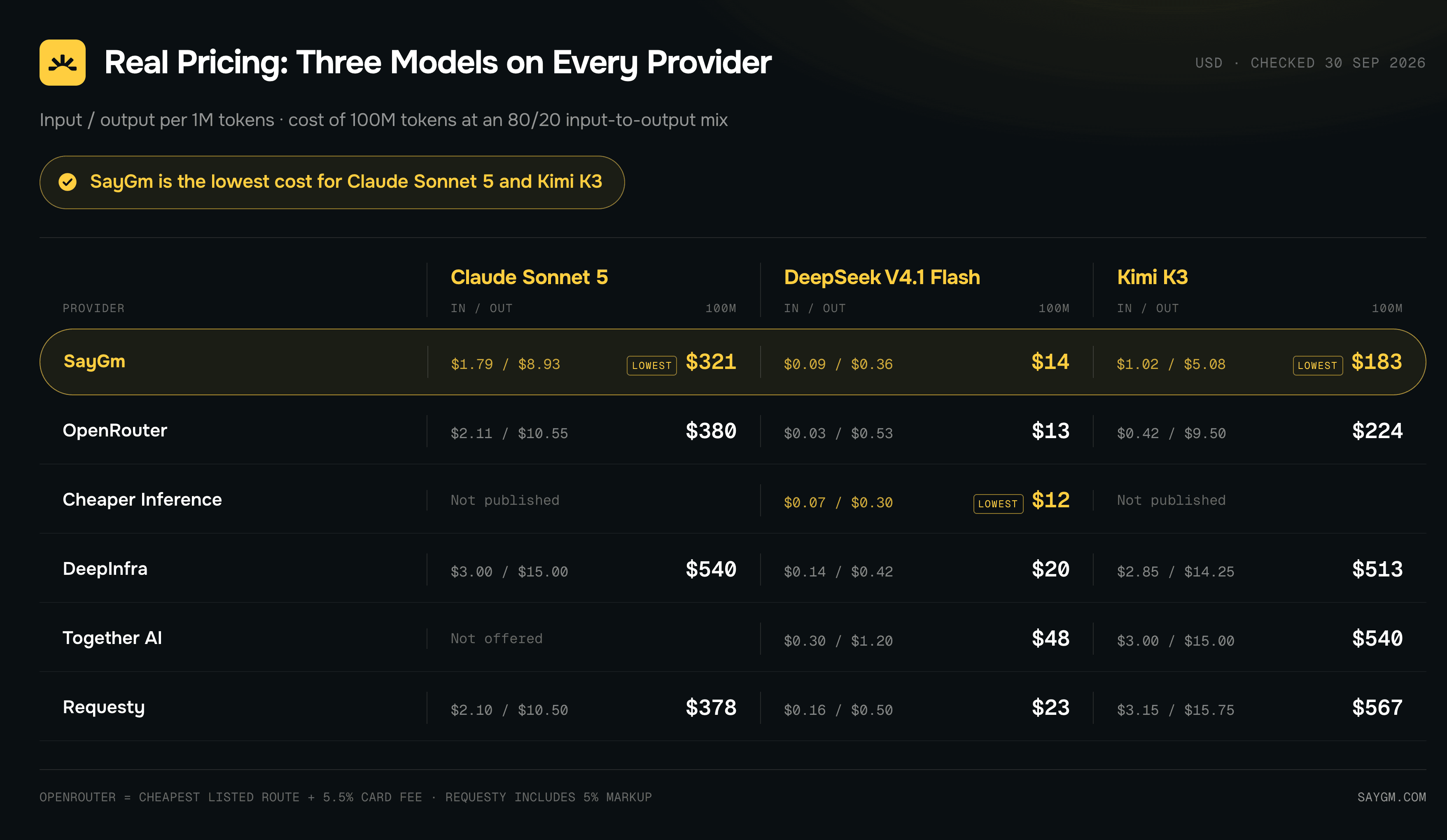
Fee structures are hard to compare in the abstract, so here is what the same three models cost on each provider, checked 30 September 2026. Each cell shows input and output per million tokens, then what 100 million tokens costs at an 80/20 input-to-output mix. OpenRouter is its cheapest listed route with the 5.5% card fee added. Requesty includes its 5% markup.
| Provider | Claude Sonnet 5 | DeepSeek V4.1 Flash | Kimi K3 |
|---|---|---|---|
| SayGm | $1.79 / $8.93 · $321 | $0.09 / $0.36 · $14 | $1.02 / $5.08 · $183 |
| OpenRouter | $2.11 / $10.55 · $380 | $0.03 / $0.53 · $13 | $0.42 / $9.50 · $224 |
| Cheaper Inference | Not published | $0.07 / $0.30 · $12 | Not published |
| DeepInfra | $3.00 / $15.00 · $540 | $0.14 / $0.42 · $20 | $2.85 / $14.25 · $513 |
| Together AI | Not offered | $0.30 / $1.20 · $48 | $3.00 / $15.00 · $540 |
| Requesty | $2.10 / $10.50 · $378 | $0.16 / $0.50 · $23 | $3.15 / $15.75 · $567 |
SayGm is the cheapest on Claude Sonnet 5 and Kimi K3. On Kimi K3, 100 million tokens costs $183 on SayGm against $224 on OpenRouter's cheapest route and over $500 everywhere else. DeepSeek V4.1 Flash is the exception: Cheaper Inference's published rate and OpenRouter's cheapest route both come in a dollar or two under SayGm. Our DeepSeek pricing breakdown covers every route for that model, and there are full provider comparisons for Kimi and GLM too.
Cheaper Inference only publishes a handful of rates on its homepage; the rest of its pricing is behind a login.
What Makes a Real OpenRouter Alternative in 2026?
A unified API, or AI aggregator, gives you one key and one bill for models that would otherwise mean separate accounts, SDKs, and rate limits per provider. That part of the pitch is now table stakes: most gateways worth considering, OpenRouter included, are drop-in compatible with the OpenAI SDK, so switching is usually a base URL change rather than a rewrite.
There are plenty of sites like OpenRouter now. What separates a good OpenRouter alternative from a lateral move is cost structure (does the platform add a fee on top of what the model maker charges, and how is that fee disclosed) or trust model (does "private" mean a policy promise, or something that can be verified). The five alternatives below split across both.
Top 5 OpenRouter Alternatives
1. SayGm
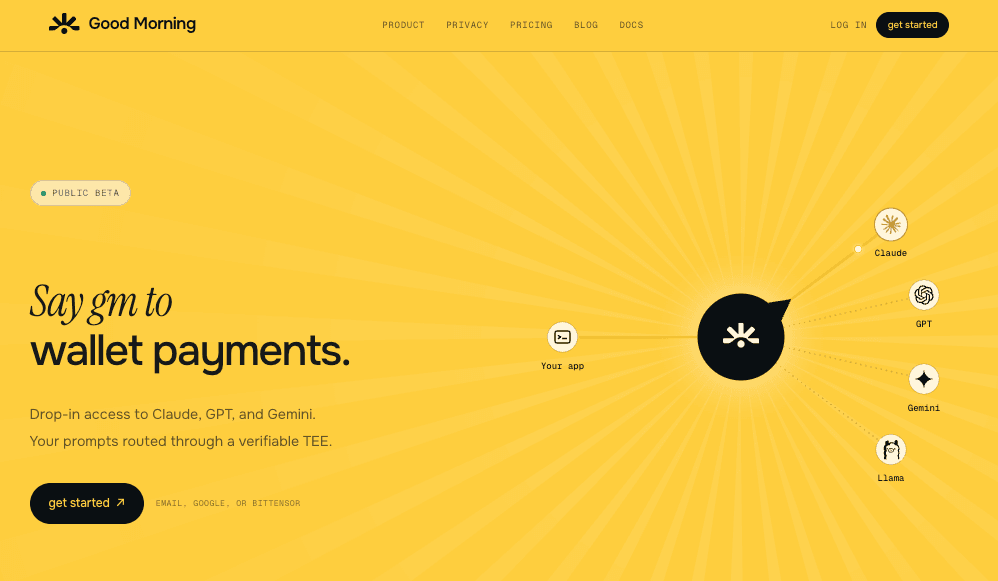
SayGm is a drop-in inference gateway compatible with the OpenAI, Anthropic, and Gemini SDKs you're likely already using, with open-weight prompts routed through an Intel TDX trusted execution environment (TEE) instead of a privacy policy.
Pricing: No subscription, no credit-purchase fee. Rates are published in a live, machine-readable model catalog, which currently shows an average discount of about 33% against published retail across 62 live models. Frontier models run about 19% below retail on average and open-weight models about half off, with individual models ranging from 5% to over 90%. Per-model breakdowns: Kimi, GLM, DeepSeek and Qwen.
Frontier models (Claude, GPT, Gemini) use anonymous routing, meaning the provider still receives the prompt but never sees who sent it. Open-weight models on sealed routes (GLM, Qwen, DeepSeek, Kimi, and others) run inside the TEE itself, so the prompt is never visible in the clear, not even to SayGm.
Best for: Developers and teams who want OpenRouter's convenience without taking a privacy policy on faith, and who'd rather see live per-token pricing than a platform fee.
2. Cheaper Inference
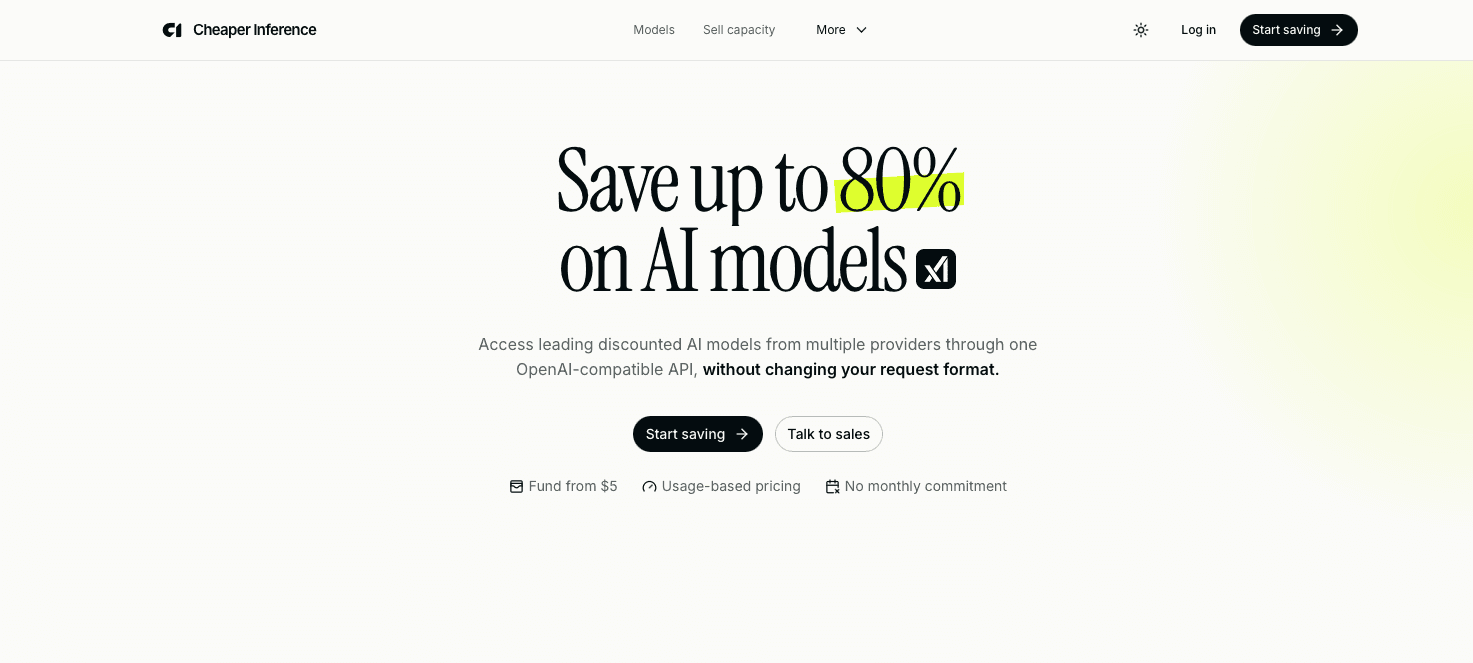
Cheaper Inference is a marketplace reselling discounted access to 72 models through an OpenAI-compatible API, including OpenAI, Anthropic, Google, DeepSeek and Z.ai, plus image, video and audio models from Black Forest Labs, Kuaishou and ElevenLabs.
Pricing: Usage-based with no monthly commitment, funded from a $5 minimum. The pitch is "marketplace prices, never above list", with discounts of 30-50% off standard rates on listed models.
The trade-off: Cheaper Inference says it records usage and billing metadata only, never prompt or response bodies, with zero data retention available on supported routes. There is no hardware attestation, so both the retention promise and which model version actually served the request are taken on trust. Cheaper Inference also do not provide attestation to prove that the model you purchase is the one you are truly being served.
Best for: Teams that want one discounted account covering text, image and video models, and are comfortable with a policy-based privacy model.
3. DeepInfra
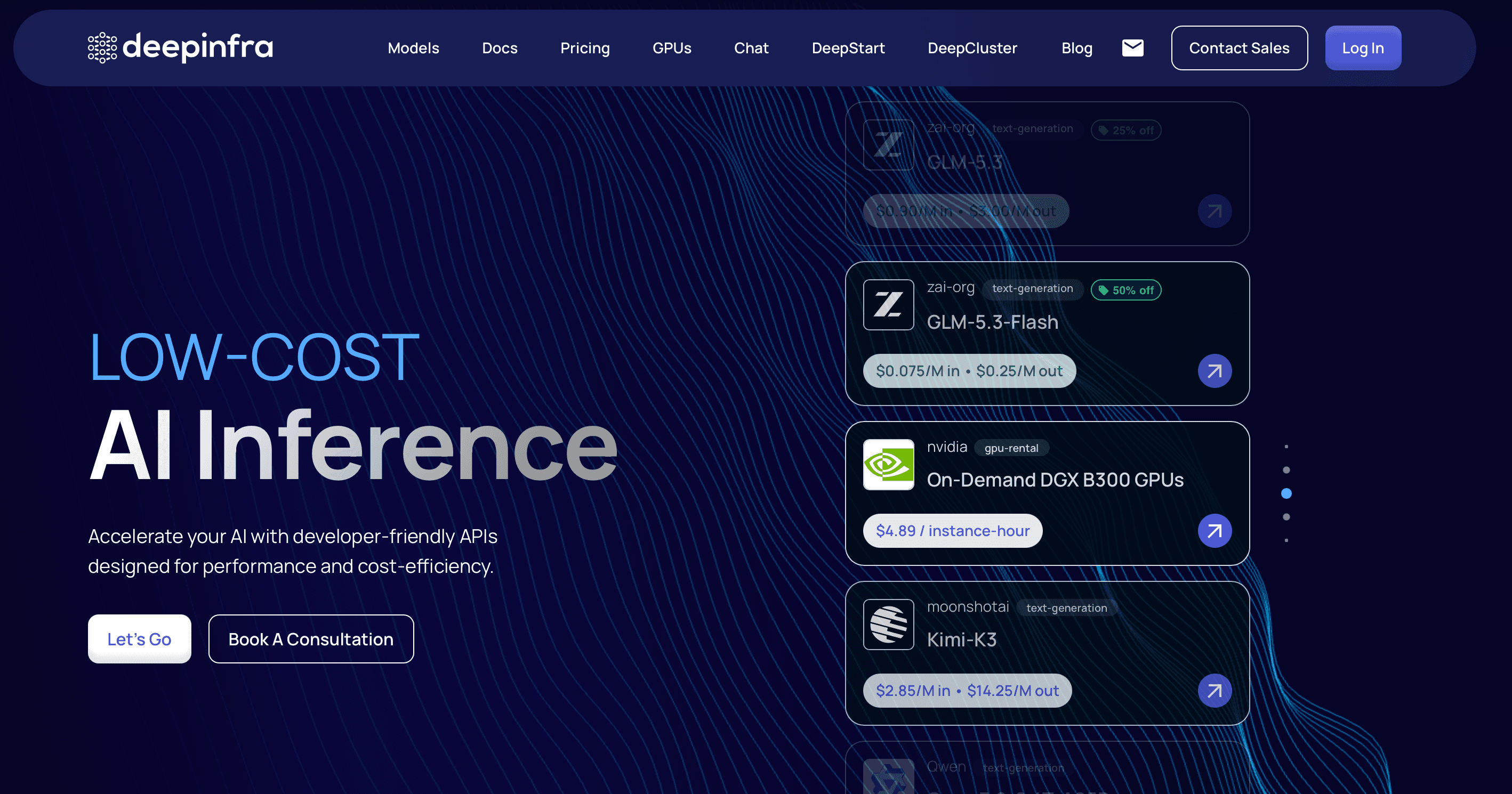
DeepInfra is one of the established inference hosts, serving 100+ models through an OpenAI-compatible API. Open-weight models are its core, and it now also lists Claude and Gemini.
Pricing: Pay per token with no contracts or upfront costs. Two dials on top of the standard rate: Priority at 1.5x for queue position when latency matters, and Flex at 0.8x for asynchronous batch work.
Privacy: Policy-based. DeepInfra's privacy policy says it will "not store, sell, or train using this data unless we have your explicit consent." There is no confidential compute option.
Best for: Teams running open-weight models at volume who want an established host, and a batch discount for work that can wait.
4. Together AI
Together AI is one of the largest open-weight inference platforms, serving 200+ models across text, image, video and audio. Its API is compatible with the OpenAI SDKs, so switching is a base URL change.
Pricing: Pay per token with separate input and output rates, and no subscription or platform fee. Batch inference runs at a discount for work that can wait. Beyond serverless, Together sells dedicated single-tenant endpoints priced per GPU hour, fine-tuning on 20+ models, and GPU clusters from $1.99/hour for preemptible H100s.
Privacy: Policy-based. Together says it does not train on customer data "without your explicit opt-in and consent", and offers a zero data retention setting. There is no hardware attestation.
Best for: Teams that have settled on open-weight models and want inference, fine-tuning and dedicated capacity from one vendor.
5. Requesty
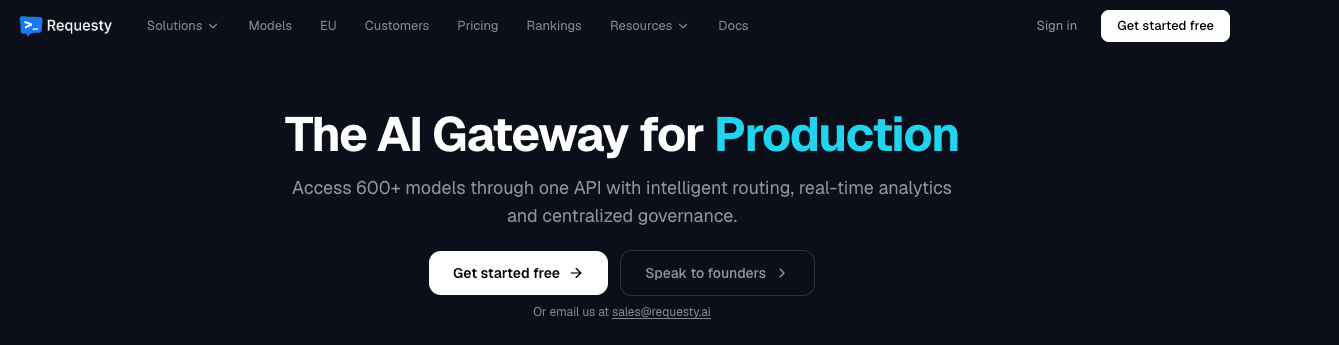
Requesty is one of the newer lightweight managed gateways built as a close functional swap for OpenRouter, with a smaller footprint and a simpler setup path.
Pricing: Usage-based, with a token markup on top of provider rates rather than a flat platform fee on credit purchases. It's a straightforward model to reason about if you're already comparing it against OpenRouter's fee structure.
Best for: Teams that want the most familiar managed swap for OpenRouter, without needing the deeper governance tooling that Portkey adds.
OpenRouter Pricing: What You Actually Pay
OpenRouter pricing passes through the underlying provider's per-token rates without a markup. What you pay instead is a 5.5% fee when you buy credits by card, with a $0.80 minimum, or 5% if you pay in crypto. On a $10,000 monthly credit purchase, that's roughly $550 going to the platform fee before a single token is billed. Our SayGm vs OpenRouter savings calculator prices that difference at your own volumes.
None of that makes OpenRouter a bad product. It remains the widest hosted-model catalog with the least setup friction, and for prototyping or low-volume multi-model testing, that convenience is real. The alternatives above tend to earn a look once the job shifts to production cost control or a privacy guarantee you can verify.
Which Alternative Should You Pick?
- Want OpenRouter's convenience with hardware-verified privacy and no platform fee: SayGm.
- Want one discounted account for text, image and video models: Cheaper Inference.
- Want open-weight models at volume from an established host: DeepInfra.
- Want open-weight inference, fine-tuning and dedicated capacity from one vendor: Together AI.
- Want the simplest managed drop-in swap for OpenRouter: Requesty.
Common Questions about OpenRouter Alternatives
Is there a free OpenRouter alternative?
Partly. Requesty offers a free tier at 200 requests a day, and OpenRouter itself lists some free model variants. SayGm doesn't have a free tier, but there's no subscription or credit-purchase fee either, so cost is entirely usage-based against published, per-model rates.
What is the cheapest OpenRouter alternative?
It depends on the model. On raw per-token cost with no platform fee on top, SayGm's live catalog is the one to check first, since pricing moves with provider competition rather than sitting behind a fixed markup. Our per-model posts compare every provider for Kimi, GLM, DeepSeek and Qwen.
Do these alternatives support the same models as OpenRouter?
Coverage varies. OpenRouter's catalog is one of the largest at 500+ models, and Requesty claims 600+. SayGm's catalog is smaller at 62 live models, but covers the frontier models most developers reach for, Claude, GPT, and Gemini, plus open-weight models like DeepSeek, Kimi, GLM, and Qwen.
Final Thoughts
OpenRouter earned its default status honestly: broad catalog, fast setup, no per-token markup on the models themselves. But the first gateway you try is not always the right one for production. If cost transparency and a privacy guarantee you can verify matter for what you're building, SayGm's live pricing is worth putting next to whatever you're using today.
Ready to compare it yourself? Get an API key and swap in your existing OpenAI, Anthropic, or Gemini code, no rewrite required. The quickstart guide walks through the base URL change end to end.
About SayGm
SayGm is a drop-in inference gateway for teams who don't want to just take a company's word that their prompts are private. Route to a confidential model and your prompt is sealed inside hardware-verified execution, where not even SayGm can see it. That's not a policy, it's provable. Swap in your existing OpenAI, Anthropic, or Gemini code and you're covered in minutes, at transparent, published rates with no hidden markup.
Say gm to AI at saygm.com.
- Inference
- LLM Gateway
- OpenRouter
BS