Qwen3.8 27B API Pricing 2026: Cost and Cheapest Providers
Qwen3.8 27B costs $0.05 per million input tokens on SayGm, against a $0.50 retail rate. Here's what the main providers charge, what the rest of the Qwen family costs, and what you need to run it yourself.
BSBrittany Seales· Marketing5 min read
On this page
Qwen3.8 27B costs $0.05 per million input tokens and $0.30 output on SayGm, the cheapest of the 17 providers serving it. The published retail rate is $0.50 and $3.00.
On a normal 80/20 mix, 100 million tokens costs $10 on SayGm, $50 on DeepInfra, $85 direct from Alibaba and $100 at retail.
Table of Contents
- The cheapest Qwen3.8 27B provider
- Qwen3.8 27B providers compared
- Pricing for the rest of the Qwen family
- Qwen3.8 27B and confidential inference
- Qwen3.8 27B hosting: running it yourself
- Calling Qwen3.8 27B on SayGm
- Qwen3.8 27B pricing FAQ
- The bottom line
- About SayGm
Alibaba released Qwen3.8 27B on 14 August 2026 under Apache 2.0, which permits commercial use with no revenue share. That licence is why 17 providers serve it and why the market price sits so far below retail.
It is a 27-billion-parameter dense model, not a mixture of experts, with a 262K native context extending to 1M through YaRN, and it takes text, images and video as input. On Alibaba's own evaluations, reported in the release coverage, it scores 61.7% on SWE-bench Pro against 53.4% for Claude Opus 4.6 Max, and 42.2% on DeepSWE 1.1 against 13.3% for Qwen3.6-27B. Those figures have not been independently reproduced.
The published retail rate is $0.50 input and $3.00 output per million tokens, though most providers charge well below.
The cheapest Qwen3.8 27B provider
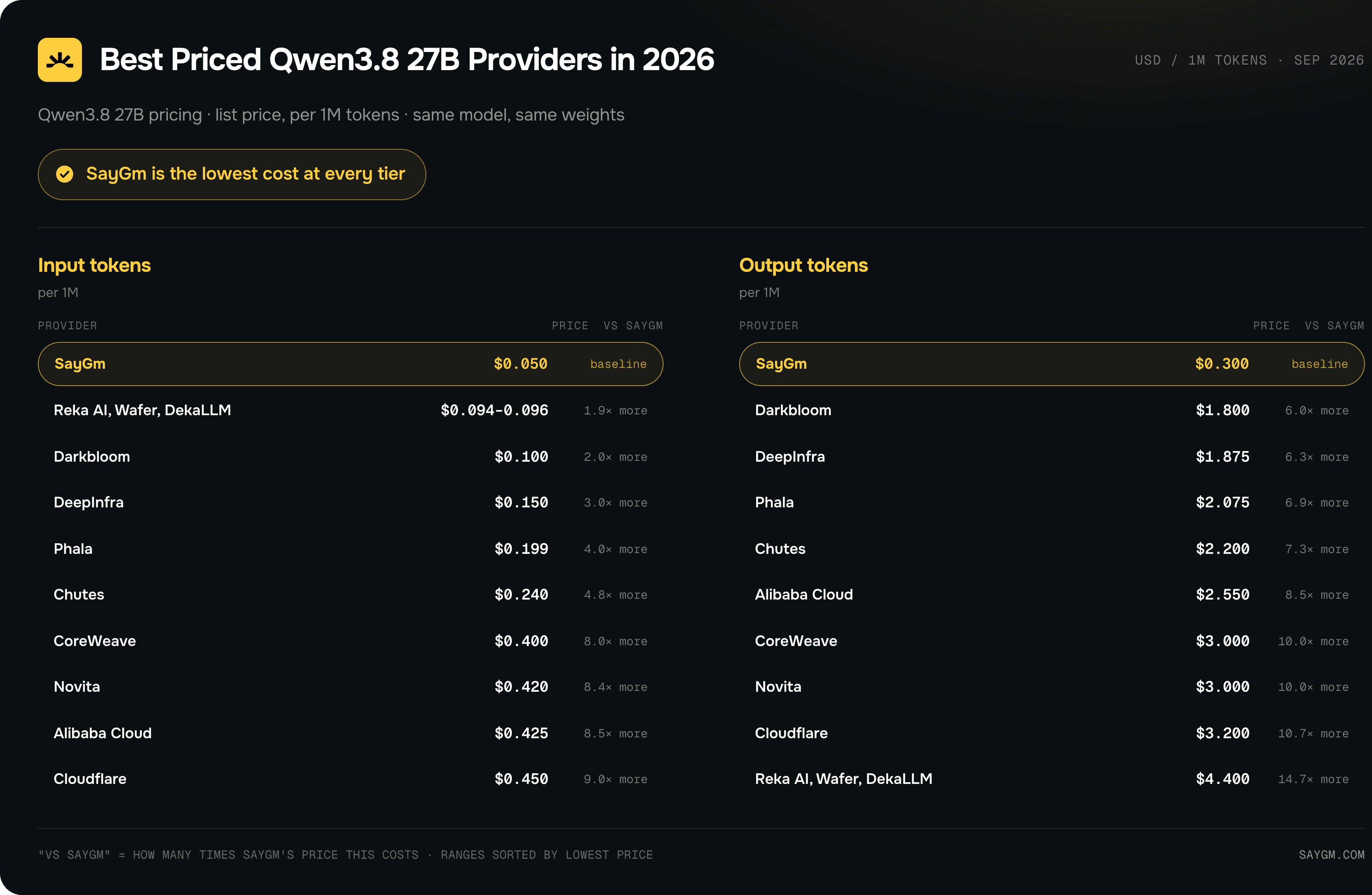
SayGm, at $0.05 input and $0.30 output, with cached reads at $0.01. Qwen3.8 27B API pricing for the ten providers worth comparing, from SayGm's catalog and OpenRouter's endpoint data, checked 25 September 2026. These move week to week. Parasail, AkashML, Mancer, Ionstream and Venice all sit in the $63 to $100 band and are left out for space.
| Provider | Input | Output | Cache read | Precision | Max output | Per 100M tokens |
|---|---|---|---|---|---|---|
| SayGm | $0.050 | $0.300 | $0.010 | not published | - | $10 |
| Darkbloom | $0.100 | $1.800 | - | FP4 | 33K | $44 |
| DeepInfra | $0.150 | $1.875 | $0.038 | BF16 | 236K | $50 |
| Phala | $0.199 | $2.075 | $0.042 | unknown | 236K | $57 |
| Chutes | $0.240 | $2.200 | $0.024 | FP8 | 66K | $63 |
| Alibaba Cloud | $0.425 | $2.550 | $0.085 | unknown | 131K | $85 |
| CoreWeave | $0.400 | $3.000 | $0.150 | FP8 | 236K | $92 |
| Novita | $0.420 | $3.000 | $0.085 | unknown | 131K | $94 |
| Reka AI, Wafer, DekaLLM | $0.094-0.096 | $4.400 | $0.085-0.087 | unknown | 131-236K | $96 |
| Cloudflare | $0.450 | $3.200 | $0.050 | unknown | 236K | $100 |
The last column assumes 80 million input tokens and 20 million output, a normal agentic mix. At a billion tokens a month the spread runs from $100 on SayGm to $1,000 on Cloudflare.
Qwen3.8 27B providers compared
The providers most teams will consider, and what each one is good for:
SayGm
$0.05 in and $0.30 out, with cached reads at $0.01, which works out at $10 per 100 million tokens and makes it the cheapest route on this list by a factor of four. That is the standing rate in our published catalog, not a promotional tier: providers compete to serve requests and the rate falls out of that. There is no subscription and no top-up fee. What SayGm does not offer on this model: a sealed route (qwen3.8-27b is standard, see below), dedicated deployments, fine-tuning, or a published precision. If you need the cheapest way to run a Qwen agent loop at volume, this is it.
Alibaba Cloud (direct)
$0.425 and $2.550, below the published retail rate but above almost every third party, at $85 per 100 million tokens. Going to the source buys two real things: the full 1M context window, which only one other provider serves, and first access to new checkpoints. Uptime was 99.89%, at the top of the set. The cost is the cost, 1.7 times DeepInfra and more than eight times SayGm, and requests are processed by Alibaba. Go direct if you need the million-token window or day-one checkpoints; go elsewhere if the bill matters.
OpenRouter
Where most developers first meet a new open-weight model, and for Qwen3.8 27B it puts 16 providers behind one endpoint. Inference is passed through at each provider's rate; the cost is a fee on credit top-ups, 5.5% by card and 5% by crypto. What you get is routing: sort modes for price, speed or throughput, automatic failover when a provider errors, per-provider uptime and precision data, and data-policy filters so you can exclude providers that train on prompts. The endpoint data in the table above is OpenRouter's, and it is the best public source on this model. What a router structurally cannot do is seal the prompt: it sees every request in the clear, and its privacy is whatever the downstream provider's policy says. We set the two models out in SayGm vs OpenRouter.
DeepInfra
$0.150 and $1.875, $50 per 100 million, and the only provider serving Qwen3.8 27B at BF16. If you are comparing quality across cheap routes, this is the reference: everyone else is at FP8 or lower, or has not said. Cache reads are $0.038, the cheapest after SayGm and Chutes, which matters on repeated system prompts. Uptime was 99.67%. It is roughly five times SayGm on a normal mix, and there is no confidential compute option, but for a team that wants unquantised weights and a mainstream vendor it is the straightforward pick.
Cloudflare Workers AI
$0.450 and $3.200, $100 per 100 million, which is the retail rate with no discount at all, and uptime was 94.33%, the worst in the set by a wide margin. What you are buying is adjacency: if your application already runs on Workers, inference at the edge next to it removes a network hop and a vendor. That is a real architectural argument. It is not a price argument, and on this model it is not a reliability argument either.
Pricing for the rest of the Qwen family
3.8-27B is the current release, but plenty of production traffic still runs against earlier versions, and the larger mixture-of-experts models remain the right choice for some work. SayGm rates for the family:
| Model | Input | Output | Cache read |
|---|---|---|---|
| qwen3.8-27b | $0.050 | $0.300 | $0.010 |
| qwen3.6-35b-a3b | $0.052 | $0.310 | $0.052 |
| qwen3.6-27b-tee | $0.147 | $0.982 | $0.015 |
| qwen3.5-397b-a17b-tee | $0.155 | $1.034 | $0.016 |
| qwen3-235b-a22b-thinking-2507-tee | $0.145 | $0.580 | $0.014 |
| qwen3-32b-tee | $0.051 | $0.204 | $0.005 |
Two things worth noting. The 397B mixture-of-experts model costs three times 3.8-27B on input and is the one to reach for on long-context reasoning, not general throughput. And 3-32B is cheaper than 3.8-27B on output despite being the older, larger model, because output pricing tracks what providers are willing to bid rather than parameter count. The full catalog has current rates for every route, and our pricing page covers billing.
Qwen3.8 27B hosting: running it yourself
The weights are Apache 2.0, so self-hosting is a real option in a way it is not for a frontier model. What it takes, per Yotta Labs' hardware breakdown:
| Precision | VRAM | GPU class |
|---|---|---|
| BF16 | ~56GB | H100, H200, RTX Pro 6000 |
| FP8 | ~28GB | L40S, RTX Pro 6000 |
| 4-bit | ~14-16GB | RTX 4090, RTX 5090 |
Those figures are the weights alone. KV cache sits on top and grows with context length and concurrency, which is what usually pushes a 56GB model onto an 80GB card.
At 4-bit on a 4090 this is genuinely runnable on a desk, which makes it a reasonable choice for local development. For production, do the comparison directly: take your monthly token volume at $10 per 100 million, then price an always-on 80GB instance at your cloud's hourly rate and add the ops time. Self-hosting wins when the instance is busy most of the day and you need the weights on your own hardware for other reasons.
Qwen3.8 27B and confidential inference
Private Inference is coming soon to qwen3.8-27b.
For a confidential Qwen, use qwen3.6-27b-tee, qwen3.5-397b-a17b-tee, qwen3-235b-a22b-thinking-2507-tee or qwen3-32b-tee, priced in the family table above. These run inside Intel TDX enclaves where nobody can read the prompt, including us, and each session returns an attestation report you can verify yourself.
Calling Qwen3.8 27B on SayGm
A base URL and a model ID:
from openai import OpenAI

client = OpenAI(
    base_url="https://api.saygm.com/v1",
    api_key="YOUR_SAYGM_KEY",
)

response = client.chat.completions.create(
    model="qwen3.8-27b",
    messages=[{"role": "user", "content": "Extract the line items from this invoice."}],
)
print(response.choices[0].message.content)
The Qwen3.8 27B model page carries the live rate, throughput and success rate, and the quickstart covers keys.
Qwen3.8 27B pricing FAQ
How much does the Qwen3.8 27B API cost?
Qwen3.8 27B API pricing starts at $0.50 input and $3.00 output per million tokens at the published retail rate. Third-party providers run from $0.05 to $0.45 on input and $0.30 to $4.40 on output. SayGm is $0.05 and $0.30, which works out at $10 per 100 million tokens.
Is Qwen3.8 27B cheaper than Kimi, GLM or DeepSeek?
Yes, on every route we have compared. It is the cheapest of the four open-weight families on SayGm, which is what you would expect from a 27B dense model against much larger mixtures of experts. The trade is capability at the top end. See Kimi API pricing, GLM pricing and DeepSeek API pricing for the numbers.
Is there a free Qwen3.8 27B API?
OpenRouter lists a free variant at qwen/qwen3.8-27b:free with a 262K context rather than the full million. Free endpoints on routers are rate-limited and tend to disappear when the sponsoring provider's budget does, so they suit experiments rather than anything you are shipping.
Qwen3.8 27B or Qwen3.6 27B?
3.8, unless you have validated against 3.6 and cannot move. The jump on DeepSWE 1.1 is 13.3% to 42.2% on Alibaba's evals, and 3.8 adds image and video input that 3.6 does not have.
Can Qwen3.8 27B run on a single GPU?
Yes. 4-bit quantised it needs 14 to 16GB, which fits a 4090. At full BF16 precision it needs about 56GB plus KV cache, so an 80GB card.
The bottom line
Qwen3.8 27B is an Apache 2.0 model that scores above Claude Opus 4.6 Max on SWE-bench Pro on Alibaba's own evals, and costs a tenth of what Alibaba charges for it if you buy it from the right place. SayGm is $0.05 and $0.30, or $10 per 100 million tokens.
Point your OpenAI client at api.saygm.com/v1, set the model to qwen3.8-27b, and say gm to AI.
About SayGm
SayGm is a drop-in inference gateway for teams who don't want to just take a company's word that their prompts are private. Route to a confidential model and your prompt is sealed inside hardware-verified execution, where not even SayGm can see it. That's not a policy, it's provable. Swap in your existing OpenAI, Anthropic, or Gemini code and you're covered in minutes, at transparent, published rates with no hidden markup.
Say gm to AI at saygm.com.
- Pricing
- Qwen
BS