What is an LLM Gateway (and Why Attestation Matters)
An LLM gateway used to be judged purely on routing and failover. What's changed is that whoever operates it is also structurally positioned to see everything passing through, which is why hardware attestation is starting to matter as much as uptime. Here's the difference between a gateway that promises it won't look and one that can't.
BSBrittany Seales· Marketing5 min read
On this page
An LLM gateway (some call it an AI gateway) sits between your application and the model providers you call, giving you one endpoint, one API key, and one billing relationship instead of a separate integration for every provider. That's the standard definition, and it's been true since the category existed. What's changed more recently is which part of that setup you're actually being asked to trust, and whether you can check it yourself instead of taking someone's word for it. For a look at what that trust question looks like when it's actually solved, see how SayGm approaches it.
Table of Contents
- What Is an LLM Gateway?
- Why Teams Add One
- The Trust Problem Every Gateway Shares
- Two Ways Gateways Handle Trust: Policy vs. Attestation
- How Attestation Actually Works
- What to Check Before Choosing One
- Frequently Asked Questions
What Is an LLM Gateway?
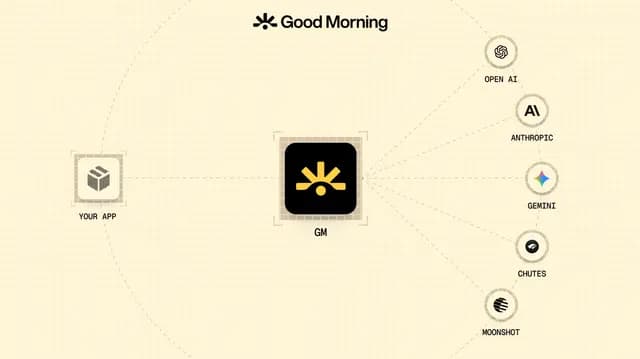
An LLM gateway is a middleware layer that normalizes calls to multiple large language model providers behind one interface, typically OpenAI-compatible, so your application code doesn't need a separate client, key, and error-handling path for every model you use. Instead of your app calling OpenAI directly, then Anthropic directly, then Google directly, it calls the gateway once, and the gateway routes the request to whichever provider and model you specified.
Most gateways handle a similar core set of jobs: unified billing across providers, automatic failover if one provider degrades or goes down, rate-limit smoothing, and a single dashboard for usage instead of five.
Why Teams Add One
The trigger is usually one specific pain point rather than a general desire for infrastructure. A few common ones:
- Provider lock-in. Code written against one provider's SDK has to be rewritten to switch, which makes testing a competing model or reacting to an outage expensive.
- Juggling multiple keys and bills. Running Claude for one feature and an open-weight model for another means separate accounts, separate rate limits, and separate invoices to reconcile.
- No failover. A single provider going down takes your feature down with it, unless something in front of it can reroute automatically.
- Cost tracking across models. Comparing spend across providers with different pricing units and dashboards is its own project without a unified view.
A gateway solves all four by sitting in the middle, and for most teams that's the entire evaluation: does it route correctly, is it reliable, and is it priced fairly. That's also exactly why the trust question underneath it gets skipped over more often than it should.
The Trust Problem Every Gateway Shares
Here's the part that doesn't show up in most feature comparisons: a gateway, by definition, sits in the path of every prompt you send. That's the whole value proposition, and it's also the whole risk. Whoever operates the gateway is structurally positioned to see, log, or inspect every request and response flowing through it, whether or not they actually do.
Most gateways address this with a privacy policy: a set of stated commitments about what gets logged, for how long, and under what opt-in conditions. Those commitments can be genuinely strong, but they share one property regardless of how well-written they are: there's no way for the person sending the prompt to independently confirm that the policy is actually what's running, rather than what's promised. It's trust by advertisement.
Two Ways Gateways Handle Trust: Policy vs. Attestation
Policy-based privacy is the default across most of the category. The gateway operator states what it does and doesn't retain, often with opt-in/opt-out settings and per-request controls. It's the same trust model as almost every SaaS product you use: a terms page and a company's track record for honoring it.
Hardware attestation is a structurally different guarantee, and it's the newer of the two approaches. Instead of a written promise, the gateway runs inside a trusted execution environment: the chip itself carves out an isolated compute region, walls it off from the host OS and hypervisor, and won't let a request through until it has produced a cryptographically signed measurement of exactly what code is running there. Anyone, not just the operator, can check that measurement against a known-good build. Encryption at rest and in transit has been solved for years; this closes the remaining gap, data exposed while it's actually being processed.
SayGm is built specifically around this second model, running its gateway inside an Intel TDX confidential VM so the privacy guarantee rests on silicon rather than a statement on a website, a full technical breakdown is in SayGm's privacy documentation. Concretely, that means the enclave produces a measurement of exactly what's running, so a security team evaluating SayGm has something to check against rather than a claim to take on faith, the same way they'd evaluate any other piece of infrastructure they didn't build themselves. For most gateways in this category, that check doesn't exist at all; trust starts and ends at the policy page.
One question worth asking any attested gateway: sealed from whom, exactly? SayGm's answer changes depending on which model you're calling. Route to an open-weight model, and inference happens fully inside the enclave, so the prompt is invisible to the model provider, the host, and SayGm itself. Route to a frontier model like Claude, GPT, or Gemini instead, and the guarantee is narrower: identity-blind, anonymous routing, but the model maker on the other end still receives the prompt content, same as it would calling that provider directly. Neither guarantee is fake, but they're not the same guarantee, and a gateway that markets them as one blanket "can't be read" claim is overstating what it actually built.
How Attestation Actually Works
Concretely, the flow looks like this: your request reaches the gateway, the gateway's enclave produces a signed attestation report describing exactly what software is running, and that report can be verified against a reference measurement before the request is processed. This is remote attestation in practice: the check happens from outside the enclave, by whoever needs to trust it, not as a claim the enclave makes about itself. If the running code doesn't match what it's supposed to be, whether from tampering or an unauthorized change, the mismatch is detectable rather than silent. Google Cloud's confidential computing documentation describes this as the missing third leg of encryption, protecting data in use, alongside the encryption at rest and in transit that most infrastructure already handles.
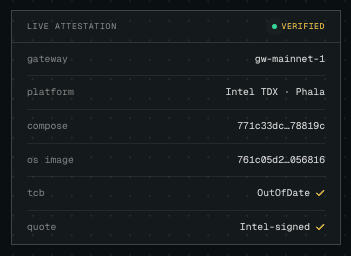
The practical difference for you as a buyer: verifying a policy means reading a document and deciding whether to trust the company that wrote it. Verifying attestation means checking a cryptographic proof, which doesn't depend on trusting anyone.
What to Check Before Choosing One
- What's the trust model, specifically? Ask whether privacy rests on a policy, a technical control like anonymization, or hardware attestation, and don't accept "we take privacy seriously" as an answer to a question about mechanism.
- Is switching actually a drop-in? Confirm the gateway supports the OpenAI-compatible interface (or whichever SDK shape you're already using) so migration is a base URL and key change, not a rewrite. SayGm's quickstart guide shows what that swap looks like in practice.
- How is pricing structured? Look for markup on inference itself, separate purchase or funding fees, and whether pricing is published somewhere you can check against actual usage.
- What happens on provider failure? Ask specifically how failover works and whether it requires configuration or happens automatically.
- Can you verify the privacy claim yourself? If the answer involves checking a signed measurement rather than reading a terms page, that's attestation. If it's a terms page, it's policy, which isn't automatically wrong, just a different guarantee than it might sound like.
If you're weighing specific platforms rather than the category in the abstract, we've compared OpenRouter, LiteLLM, and SayGm directly on cost, control, and exactly this trust question.
Frequently Asked Questions
Is an LLM gateway the same as an API gateway?
They're related but not identical. A general API gateway handles routing, auth, and rate limiting for any API traffic. An LLM gateway, sometimes called an AI gateway, does the same job specifically for model providers, and typically adds LLM-specific features like token-based billing, model fallback, and prompt-level privacy controls that a generic API gateway wouldn't need. Some, like SayGm, go a step further and add hardware attestation, so the privacy control itself can be checked rather than just configured.
Do I need an LLM gateway if I only use one model?
Probably not yet. The value shows up once you're juggling multiple providers, need failover, or want centralized cost tracking. A single-provider integration doesn't need the extra layer.
Does using a gateway always mean giving up privacy?
No, but it does mean someone is structurally positioned to see your traffic unless the gateway is built specifically to prevent that. A gateway that runs inside a hardware-attested TEE, like SayGm, closes that gap structurally rather than promising not to look. The practical difference from a policy-based gateway is what happens if the promise doesn't hold: with attestation, there's a proof to check; with a policy, there isn't.
About SayGm
SayGm is a drop-in inference gateway for teams who don't want to just take a company's word that their prompts are private. Every request runs inside a hardware-verified confidential environment - not even SayGm can see what's inside it. That's not a policy, it's provable. Swap in your existing OpenAI, Anthropic, or Gemini code and you're covered in minutes, at transparent, published rates with no hidden markup.
Say gm to AI at saygm.com.
- Attestation
- LLM Gateway
- Privacy
BS