Claude Fable 5.2 Pricing: API Costs and How to Pay Less
Claude Fable 5.2 lists at $8 per million input tokens and $40 output. On SayGM it’s 38% below list at the time of writing. Here’s the full rate card, what a task really costs, and how it compares with Fable 5.1 and Opus 5.5.
BSBrittany Seales· Marketing5 min read

On this page
Claude Fable 5.2 pricing at list is $8 per million input tokens and $40 output, but on SayGM it's currently $4.94 and $24.72. Here's every rate, what a task really costs, and how it compares with Fable 5.1 and Opus 5.5.
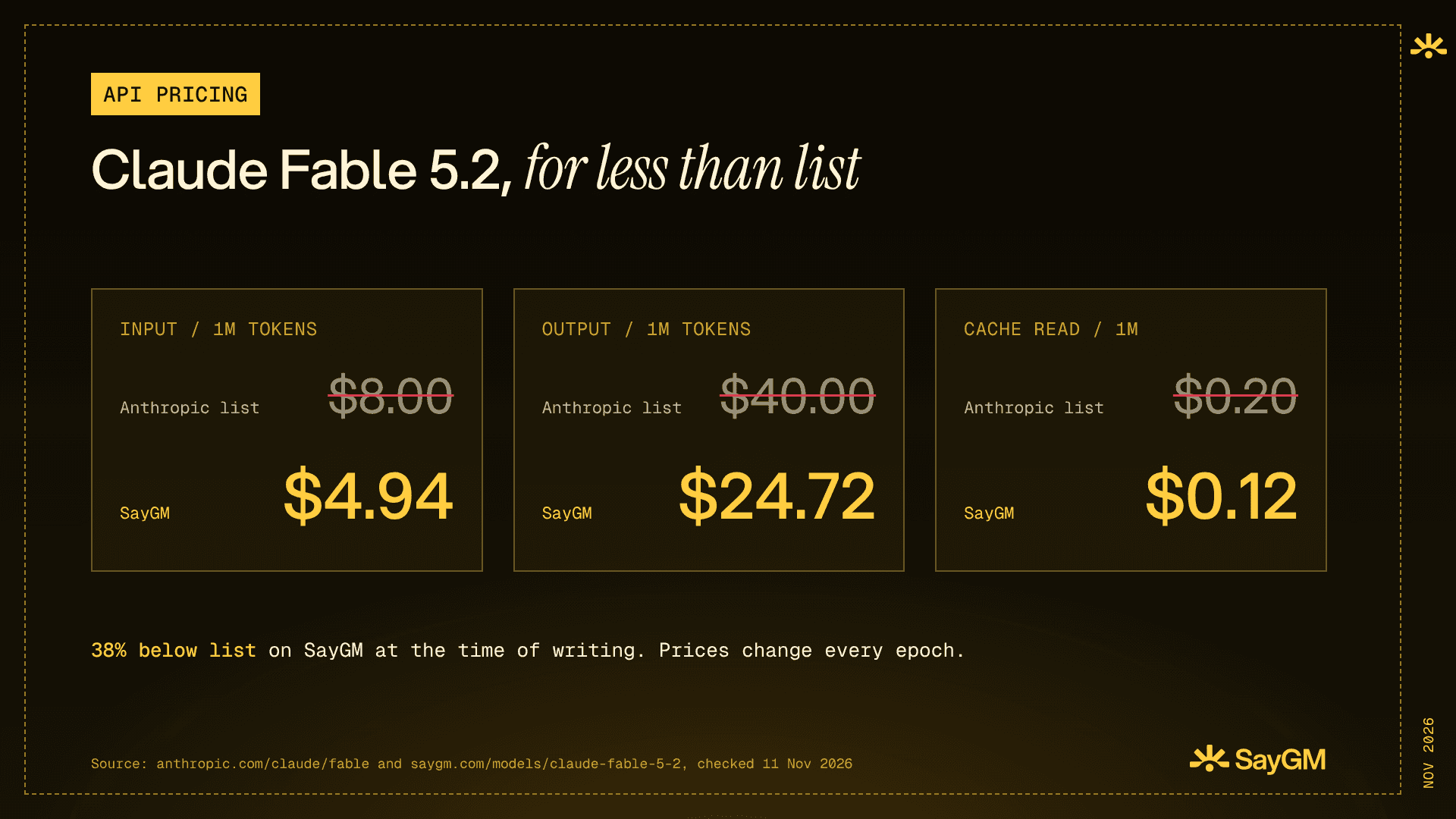
Claude Fable 5.2 costs $4.94 per million input tokens and $24.72 output on SayGM, 38% below Anthropic's $8 and $40 list price at the time of writing. That's about $890 per 100 million tokens at an 80/20 input/output mix, against $1,440 direct. If your work can wait for results, Anthropic's Batch API is cheaper still, at $4 and $20.
Claude Fable 5.2 API pricing, checked 11 November 2026
| Route | Input / M | Cache read / M | Output / M | Per 100M tokens (80/20) | Checked |
|---|---|---|---|---|---|
| SayGM | $4.94 | $0.12 | $24.72 | $890 | 11 Nov 2026 |
| Anthropic Batch API ¹ | $4.00 | - | $20.00 | $720 | 11 Nov 2026 |
| Anthropic API (list) | $8.00 | $0.20 | $40.00 | $1,440 | 11 Nov 2026 |
| Anthropic US-only inference ² | $8.80 | - | $44.00 | $1,584 | 11 Nov 2026 |
| Anthropic fast mode ³ | $16.00 | - | $80.00 | $2,880 | 11 Nov 2026 |
The 80/20 column assumes 80 million input tokens and 20 million output tokens with no caching. Your mix will differ, and agent workloads usually lean harder on cached input. SayGM rates are from the Claude Fable 5.2 model page; Anthropic rates are from Anthropic's Fable page, except the Batch rate, which is from llm-stats' launch breakdown linked below.
Table of Contents
- How much does Claude Fable 5.2 cost on SayGM?
- Fable 5.2 vs Fable 5.1 vs Opus 5.5 pricing
- What do you get for the price?
- What does a Fable 5.2 task actually cost?
- Is Claude Fable 5.2 private on SayGM?
- Calling Claude Fable 5.2 on SayGM
- Claude Fable 5.2 pricing FAQ
- The bottom line
- About SayGM
Anthropic released Claude Fable 5.2 on 9 November 2026 as its model for the hardest technical work, and it's the first Fable release to cut the base price. Fable 5 and Fable 5.1 both listed at $10 and $50; Fable 5.2 drops that by 20% across input, output and cache writes, and Anthropic says it generates output up to 30% faster than Fable 5.1. It keeps a 1M-token context window and up to 128K output tokens, per llm-stats' launch breakdown.
Fable 5.2 shares its underlying model with Claude Mythos 5.2. The difference is access: Fable 5.2 carries extra safeguards for cybersecurity and biology so it can ship to everyone, while Mythos 5.2 is limited to organizations approved through Anthropic's verification programs. This post covers Fable 5.2, the version you can actually call.
¹ Batch requests are processed asynchronously, so results arrive later rather than in real time. ² US-only inference is priced at 1.1x on input and output. ³ Fast mode generates up to 2.5x faster at twice the standard price. SayGM serves the standard model and has no batch API, so the Batch row is Anthropic only.
How much does Claude Fable 5.2 cost on SayGM?
As of 11 November 2026, Claude Fable 5.2 on SayGM costs $4.94 per million input tokens, $0.12 per million cached input tokens and $24.72 per million output tokens, 38% below list. Cache writes are $6.18 for a 5-minute cache and $9.89 for a 1-hour cache, against Anthropic's $10 and $16.
Those numbers come from how SayGM prices models. Independent providers compete to serve each model, and the best eligible bid sets the rate, capped at the model maker's list price. Default routing balances price, latency and reliability, and retries on another provider if one fails. Rates move every epoch, so the live model page is the source of truth for today's price.
Billing is prepaid credit with no subscription and no top-up fee, paid by card or crypto. The trade-offs are worth saying plainly. There's no batch API, so if your workload is happy to wait, Anthropic's Batch rate is cheaper per token than SayGM. And SayGM doesn't offer fast mode for Fable 5.2.
For a broader look at how Anthropic's own plans and API billing fit together, our Claude Code pricing guide covers the subscription side.
Fable 5.2 vs Fable 5.1 vs Opus 5.5 pricing
All three are Anthropic list prices per million tokens, as reported in llm-stats' launch breakdown and checked against Anthropic's Fable page on 11 November 2026.
| Rate per million tokens | Fable 5.2 | Fable 5.1 | Opus 5.5 |
|---|---|---|---|
| Input | $8.00 | $10.00 | $4.00 |
| Output | $40.00 | $50.00 | $20.00 |
| Cache read | $0.20 | $0.25 | $0.20 |
| 5-minute cache write | $10.00 | $12.50 | $5.00 |
| 1-hour cache write | $16.00 | $20.00 | $8.00 |
Fable 5.2 is still exactly twice the list price of Opus 5.5 on fresh input and output. The interesting line is the cache read: at $0.20, it costs the same on Fable 5.2 as on Opus 5.5, because the Fable family bills cache reads at 0.025x the input rate. For agent loops that resend a long system prompt and tool history on every turn, that narrows the real gap between the two models more than the headline rates suggest.
Anthropic is clear about where each model fits. In its launch announcement it recommends starting with Opus 5.5 as the daily driver for most coding and knowledge tasks, and reaching for Fable 5.2 when the work is ambitious, open-ended and long-running. On SayGM both sit behind one API key, so switching between them is a change to the model ID, not a new integration.
What do you get for the price?
Anthropic reports that Fable 5.2 is a step above Opus 5.5 on almost every capability it evaluated. The gaps are widest on agentic and long-horizon work: 74.6% against 58.7% on Terminal-Bench-Science, and 64.9% against 39.4% on RoboDojo's simulated robotics benchmark.
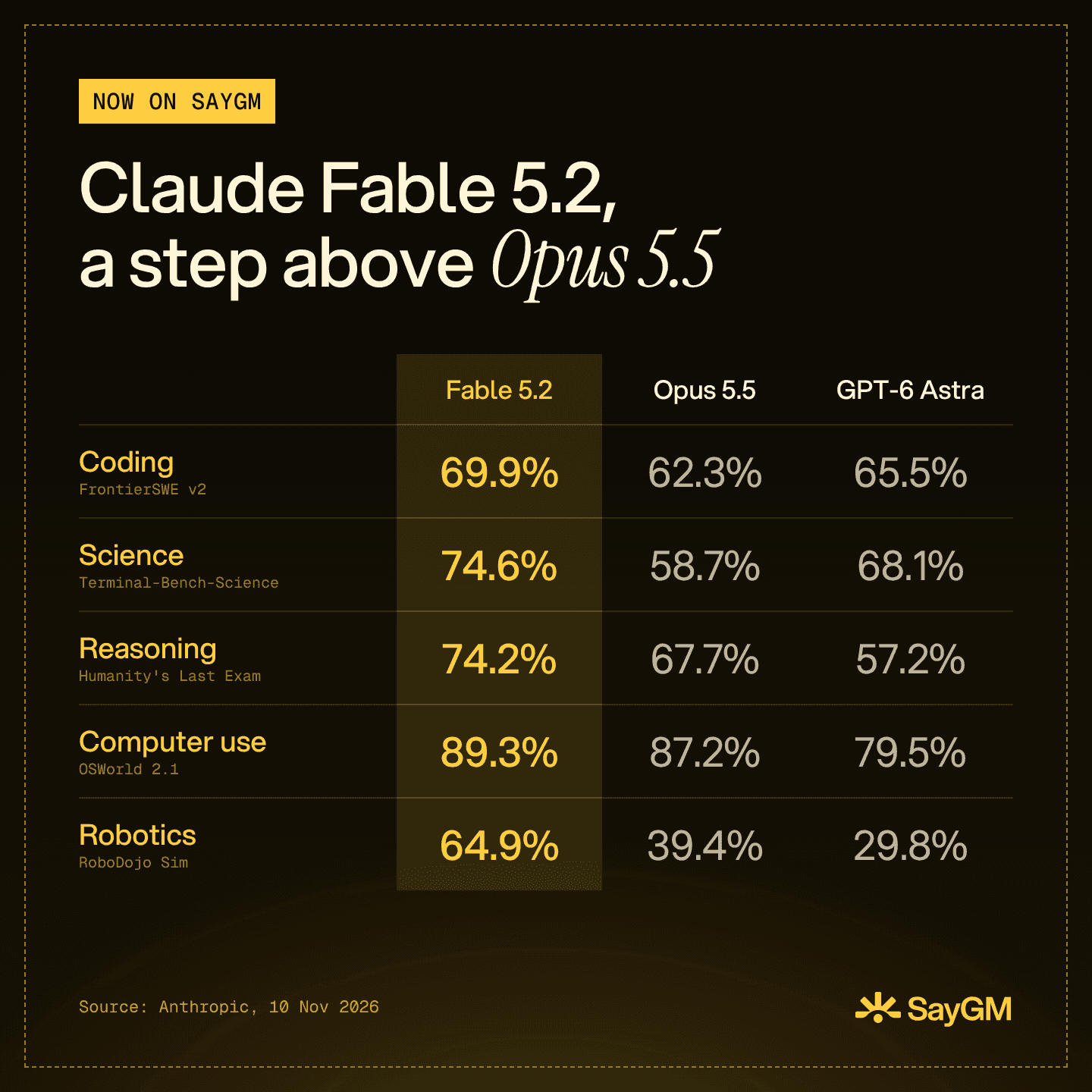
It isn't a clean sweep. On AutomationBench, which tests business workflows, Gemini 4 Carbon scored 53.9% to Fable 5.2's 51.4%, and Opus 5.5 edged it on the AA-Briefcase Elo rating. Those are the exceptions in Anthropic's table rather than the rule, but they're worth knowing if your workload looks like either one.
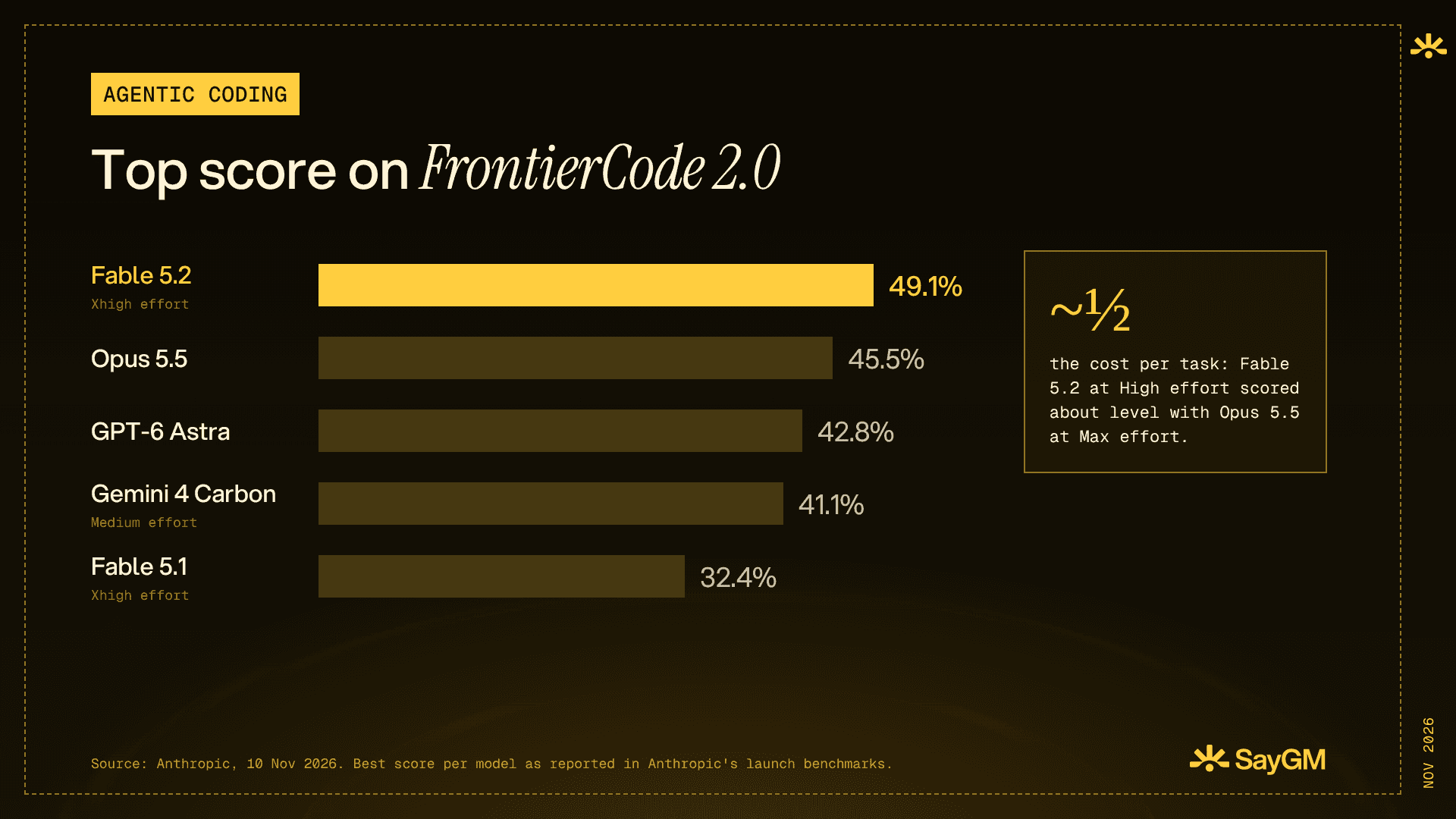
The two results that best explain the price both involve long, hard work. On FrontierCode 2.0, Fable 5.2 at Xhigh effort scored 49.1%, the highest of any released model Anthropic tested.
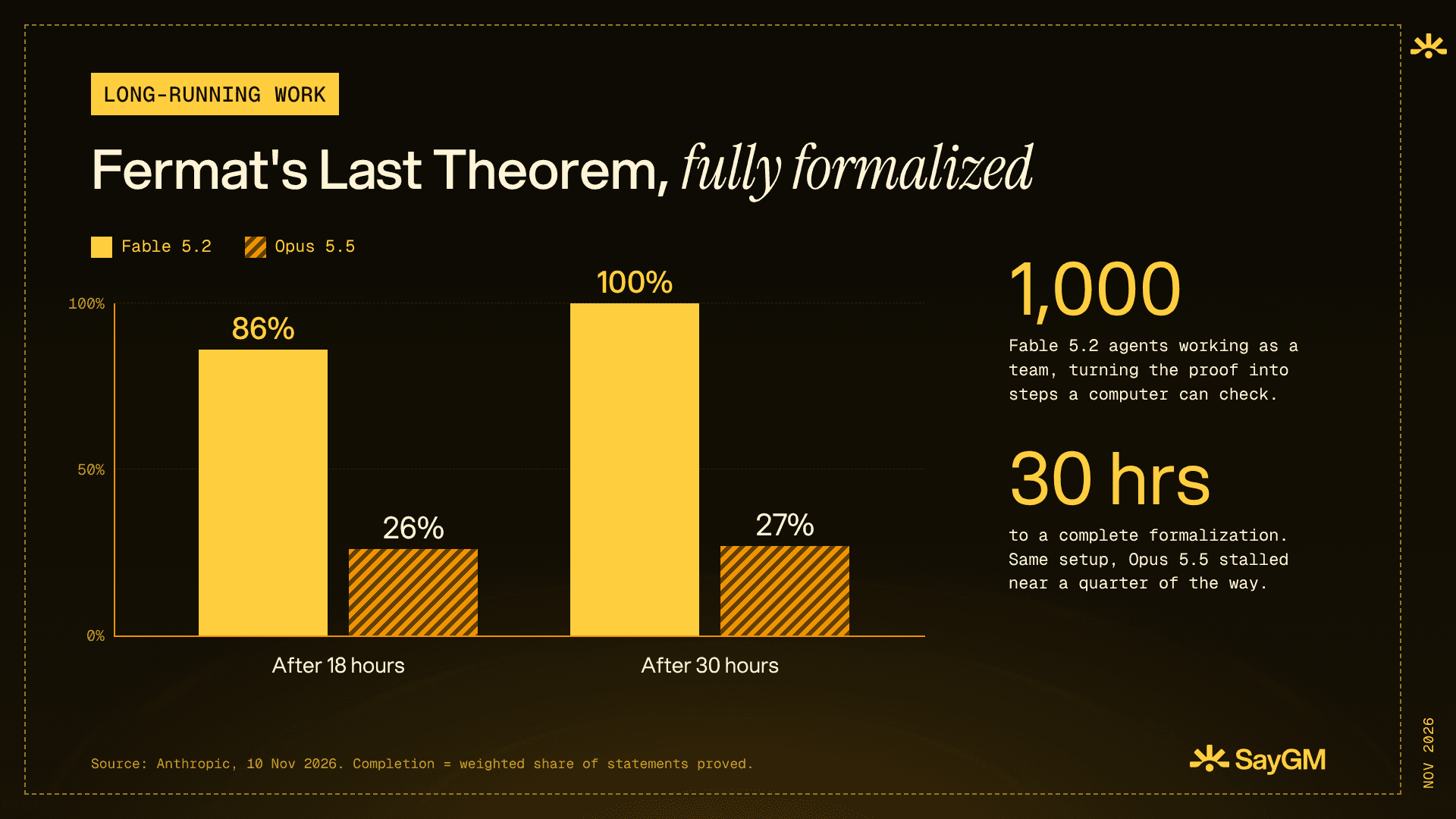
And in a longer test, a team of 1,000 Fable 5.2 agents fully formalized Fermat's Last Theorem in 30 hours, turning the proof into steps a computer can check. With the same setup, Opus 5.5 reached 26% after 18 hours and barely moved after that.
What does a Fable 5.2 task actually cost?
Per-token rates only tell you half of it. A more capable model can finish a task in fewer steps, and Fable 5.2 lets you set how hard it thinks through effort levels from Low to Max.
Anthropic's headline here is that Fable 5.2 at High effort scored about level with Opus 5.5 at Max effort on FrontierCode 2.0, for roughly half the cost per task. That's at list price on both. In other words, if you're already running Opus 5.5 at maximum effort to get hard coding tasks over the line, Fable 5.2 at High may get there for less, despite the higher per-token rate.
The reverse also holds. For everyday tasks that Opus 5.5 handles comfortably at medium effort, Fable 5.2 will usually cost more without changing the result, which is why Anthropic still points most work at Opus 5.5 first. A sensible way to decide is to run a sample of your real tasks through both and compare the bills, not the rate cards.
On SayGM, the cost-per-task maths shifts further. At the time of writing, Fable 5.2 costs about $890 per 100 million tokens at an 80/20 mix, against $1,440 at Fable 5.2's list price and $720 for Opus 5.5 at list. That closes roughly three-quarters of the per-token gap between the two models. For teams who'd ruled Fable out on price, that changes the question from "can we afford it" to "is it the right model for this job".
Is Claude Fable 5.2 private on SayGM?
SayGM's gateway runs inside a hardware-attested trusted execution environment. TLS terminates inside it, so SayGM's operators and the machine it runs on can't read your request, and anyone can check the attestation themselves without an API key.
Be precise about what that covers for Fable 5.2. It's a frontier model, so your request is sealed inside SayGM's gateway, and Anthropic still receives the prompt under its own API terms, exactly as if you called it directly. Full end-to-end confidential inference, where the model itself runs inside a TEE, applies to SayGM's open-weight confidential models, not to Claude. Our guide to private AI inference explains the difference between the two tiers.
Calling Claude Fable 5.2 on SayGM
If you already use the Anthropic SDK, it's a base URL, an API key and a model ID:
import anthropic

client = anthropic.Anthropic(
    base_url="https://api.saygm.com",
    api_key="YOUR_SAYGM_API_KEY",
)

message = client.messages.create(
    model="claude-fable-5-2",
    max_tokens=1024,
    messages=[{"role": "user", "content": "Review this migration plan for risks."}],
)
print(message.content[0].text)
OpenAI-style clients work the same way against https://api.saygm.com/v1. The quickstart covers creating a key and adding credit.
Claude Fable 5.2 pricing FAQ
How much does Claude Fable 5.2 cost?
As of 11 November 2026, Claude Fable 5.2 costs $8 per million input tokens and $40 per million output tokens at Anthropic's list price, 20% less than Fable 5.1's $10 and $50. Cache reads are $0.20 per million, and cache writes are $10 (5-minute) or $16 (1-hour). On SayGM it currently costs $4.94 input and $24.72 output, 38% below list.
Is Claude Fable 5.2 free or included in Claude Pro and Max?
There's no free access. As of 11 November 2026, Anthropic makes Fable 5.2 available on its paid Pro, Max, Ultra, Team and Enterprise plans, and it also runs in Claude Code, where medium effort is the default. How much you can use depends on each plan's usage limits, which our Claude Code pricing guide breaks down. API use, whether direct or through SayGM, is billed per token with no free tier.
Fable 5.2 vs Opus 5.5: which is cheaper?
Opus 5.5 is cheaper per token. At list, Fable 5.2 costs twice as much on input and output ($8 and $40 against $4 and $20) and the same $0.20 on cache reads. Per task the gap is smaller: Anthropic reports Fable 5.2 at High effort matches Opus 5.5 at Max on FrontierCode 2.0 for roughly half the cost per task, and on SayGM, Fable 5.2 currently closes about three-quarters of the per-token gap to Opus 5.5 at list.
What is the cheapest Claude Fable API pricing?
As of 11 November 2026, the cheapest real-time Claude Fable API pricing in our table is SayGM, at $4.94 input and $24.72 output per million tokens. For work that can wait, Anthropic's Batch API at $4 and $20 is cheaper per token. Our comparison of SayGM vs buying direct covers the wider trade-offs.
The bottom line
- Claude Fable 5.2 pricing at list is $8 input and $40 output per million tokens, 20% below Fable 5.1, with cache reads at $0.20.
- On SayGM it costs $4.94 and $24.72 at the time of writing, 38% below list, which closes most of the per-token gap to Opus 5.5.
- Fable 5.2 is twice Opus 5.5 per token at list, but Anthropic reports it can match Opus 5.5 at Max for about half the cost per task on hard coding work.
- Use Opus 5.5 for everyday tasks, and Fable 5.2 for long, open-ended technical work where the extra capability pays for itself.
Check the live Claude Fable 5.2 pricing on SayGM, then point your Anthropic SDK at SayGM's base URL and run your first request in a few minutes.
About SayGM
SayGM is a drop-in inference gateway for teams who don't want to just take a company's word that their prompts are private. Every request is routed through a hardware-verified confidential environment - not even SayGM can see what's inside it. That's not a policy, it's provable. Swap in your existing OpenAI, Anthropic, or Gemini code and you're covered in minutes, at transparent, published rates with no hidden markup.
Say gm to AI at saygm.com.
- Anthropic
- Fable
- Inference
- LLM
BS