How Ormas Runs Its AI Coding Agents on SayGM
Ormas only gets paid when the code passes. That’s why its team runs its AI coding agents on SayGM: 10+ models on one key, matched to each task, at about 12.5% under list price.
BSBrittany Seales· Marketing5 min read
On this page
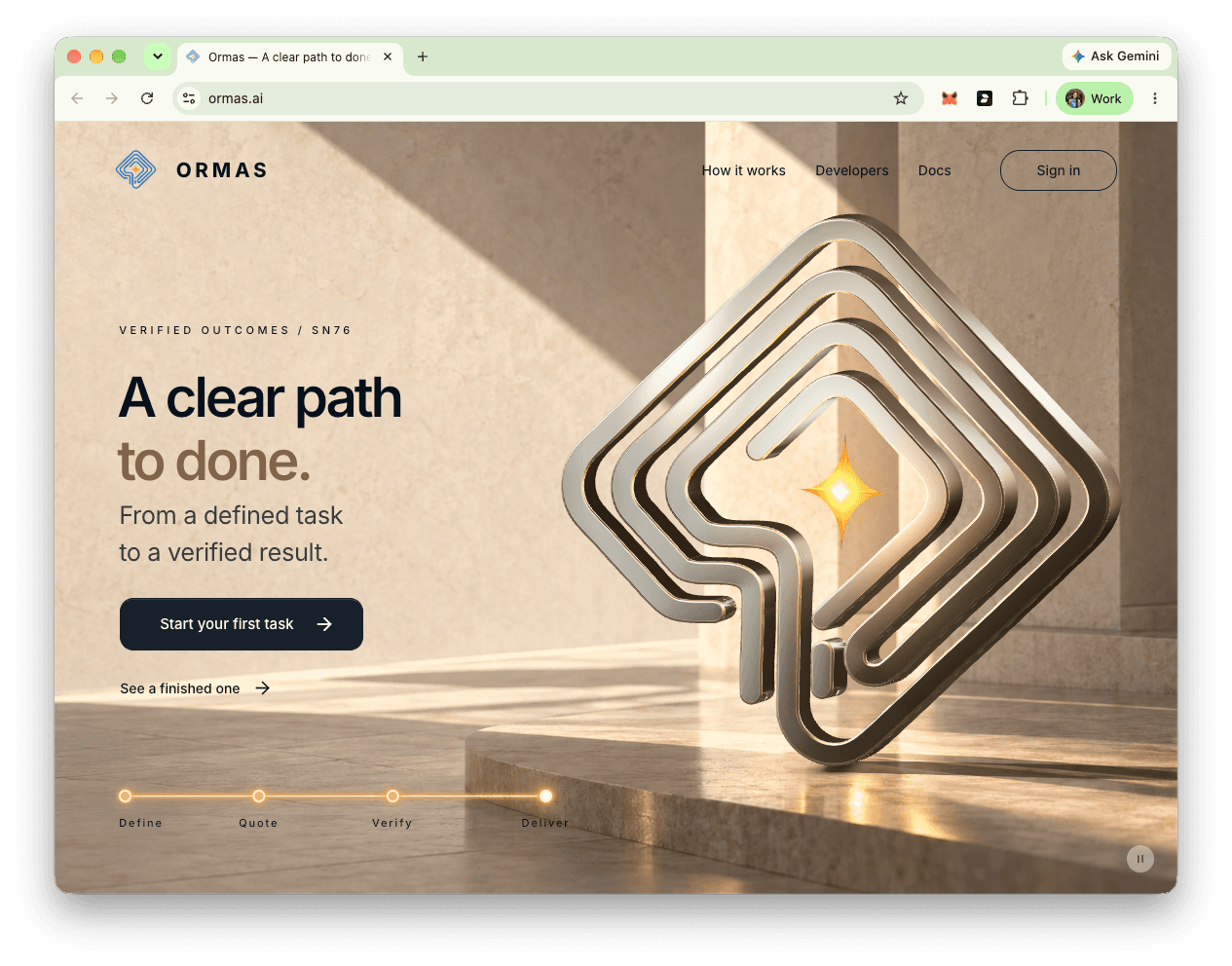
Ormas is a Bittensor subnet that delivers finished coding work, and clients only pay when the code passes their own test. The team behind it builds the platform with AI coding agents too, and the bulk of those agents' model calls run through SayGM.
So far by using SayGM, the Ormas team has paid $19,553 for usage that would have cost $22,335 at each model maker's list price, about 12.5% less for the same tokens. Ormas also recommends SayGM to the independent providers who complete tasks on their network.
This case study covers what Ormas builds, why model costs matter so much when you only get paid on acceptance, why the team chose SayGM, and how it now picks a different model for each kind of work.
Disclosure: Ormas has a referral relationship with SayGM and may earn SN28 alpha rewards from referred top-ups. This gives Ormas miners no discount or change to their terms. SayGM is optional and is never required to use or mine on Ormas.
Table of Contents
- Ormas Sells Code That Has to Pass a Test
- Every Ticket Spends Tokens Before It Earns Anything
- Why Ormas Moved Its Model Activity to SayGM
- One Key and the Right Model for Each Job
- The Numbers: $19,553 Paid Against $22,335 at List Price
- What Protected Tier Means for Sensitive Code
- Common Questions About AI Coding Agents
- TL;DR
Ormas Sells Code That Has to Pass a Test
With Ormas, a client sets the task and the test that defines success, and agrees a price up front. If the delivered code passes, the client pays. If it fails, there's no charge. The service is live in beta, handling focused jobs like bug fixes, dependency updates and small features.
Ormas's focus is the layer above inference. Models are the input, and Ormas's innovation is in everything around them: how a task is frozen into a test, how providers are matched to it, how the work is checked independently, how sensitive code stays sealed, and how payment only happens when the work passes. Each of those can improve without any single model getting better.
The work itself is done by providers, the independent developers on Ormas's network. They're paid for accepted results, not for effort, and they choose their own models and tools to get there. That choice is where model access starts to matter.
Every Ticket Spends Tokens Before It Earns Anything
Agentic coding has a cost profile that looks nothing like a chat app. An agent working a ticket reads files, plans, writes code, runs tests, reads the failures and tries again. Every one of those steps is a model call, and all of them happen before anyone knows whether the work will be accepted.
That makes model spend a real business risk for anyone working on an outcome basis. A provider who quotes $1 for a ticket and spends $1.20 on tokens to finish it has lost money on a job the client is happy with. A provider whose work fails acceptance gets nothing for the tokens at all. Ormas's own production trial on 1 October 2026 shows how tight this can be: six tickets were quoted up front, one failed its test, and that one settled at $0. The larger the task, the more work happens before anyone knows whether it will be accepted, and the more the model bill matters.
The same pressure applies to Ormas's own engineering. The team builds the protocol, the gateway and the tooling around it with AI coding agents, and those agents use a lot of models for a lot of different jobs - that's where SayGM comes in.
Why Ormas Moved Its Model Activity to SayGM
Ormas gave three reasons for the switch: discounted pricing, broad model selection, and a belief that Bittensor subnets should build on each other. Both run on Bittensor, where independent teams each operate a specialised service, a subnet, that others can plug into. That composability is the point. SayGM competes operators down to the best price for model access; Ormas competes providers on finished, tested work. Neither of these teams had to build the others' layer, and none of it would compose this easily without a shared incentive mechanism underneath. A standalone company would have to negotiate each of those relationships one contract at a time.
The pricing comes from how SayGM sets its rates. Independent operators on Bittensor Subnet 28 bid to serve each model, and the best eligible bid sets the price, capped at the model maker's list price. Rates move every epoch, but they never go above list. For a team whose margin depends on what each ticket costs to complete, a price that can only fall below the official rate is a ceiling you can plan against.
Model selection matters just as much. Instead of a separate account with each of the major LLM providers, SayGM gives one API key for Claude, GPT and Gemini alongside a curated set of open-weight and confidential models, through the native APIs coding tools already speak. Switching an agent from one model to another is a change of model ID, not a new account and a new integration.
"We moved to SayGM for discounted pricing, a broad choice of models, and because we believe Bittensor subnets should build on each other. SayGM supplies the model access. Ormas turns it into coding work that passes the client's test. That's the network doing what it was designed to do."
— Ormas Team
One Key and the Right Model for Each Job
The biggest change since the switch isn't one cheaper model. Ormas now uses several, and the choice depends on the work. Note: The usage described here comes from the Ormas team's own engineering agents, the ones that build the gateway and tooling. Providers on the network choose their own models for the jobs they take, and Ormas neither sees nor publishes that choice.
Not every step of a coding task needs the most capable model available. Reading a repo, summarising a test failure or drafting a dependency bump can go to a fast, inexpensive model. Planning a tricky refactor, or fixing a bug that has already failed twice, is worth a stronger one. With every model on one balance, Ormas can make that call per task instead of defaulting to one model for everything.
Ormas's usage shows that call being made. The team has used more than ten models on SayGM, almost all of them frontier models from two labs. One model handled more than a quarter of all requests but only about 6% of spend. At the other end, two higher-priced models carried about 82% of spend on fewer than half of the requests. Volume goes where it's cheap, and budget goes where quality counts.
SayGM's routing also retries a request on another provider if one fails, so a single provider having a bad hour doesn't stall an agent halfway through a ticket. The guide to LLM routing on SayGM explains how that choice is made.
"Every kind of work gets its own model now: cheap where cost matters, strong where quality does. SayGM lets us make that call per task and all through one key."
— Ormas Team
It's the same setup Ormas recommends to its providers, including those preparing for the Protected tier, though SayGM stays optional and is never required to mine on Ormas.
The Numbers: $19,553 Paid Against $22,335 at List Price
| Measure | Ormas on SayGM |
|---|---|
| Period | 1 September to 15 October 2026 |
| Paid on SayGM | $19,553 |
| Same usage at list price | $22,335 |
| Saving against list price | $2,782 (about 12.5%) |
| Models used | 10+ |
For a team paid only when work is accepted, every dollar saved on tokens is a dollar of margin on tickets that pass, and a dollar less lost on tickets that don't. SayGM prices change every epoch, so a figure like this describes the period it covers, not a fixed discount. Current rates for every model are on the SayGM pricing page.
The client-side promise doesn't change because of any of this. On Ormas, the client's test still decides, and the client still pays only on acceptance. Cheaper model access sits underneath that promise without bending it.
What Protected Tier Means for Sensitive Code
Ormas's Standard tier is built for code a client is comfortable sharing. The winning provider and checker can read it, and private repos are read in plaintext on the provider's machine. For sensitive codebases, Ormas is building a Protected tier with workers and checkers inside confidential VMs, hardware attestation before anyone gets repo access, and workers limited to approved inference providers.
The approved providers for this service are planned to be SayGM (Subnet 28) and Engy (Subnet 53). Operator-run Protected jobs have already reached production, while broader client access and the first independent providers are onboarding now.
That makes the confidential AI side of SayGM directly relevant to Ormas providers. SayGM's gateway runs inside an Intel TDX trusted execution environment, so SayGM's operators and the host machine can't read the code or prompts passing through it. On frontier models, the model provider still receives the prompt under its own API terms. On SayGM's confidential models (marked -tee), inference also runs inside a TEE, so the prompt stays sealed end to end. SayGM's private inference page sets out where that line sits.
Common Questions About AI Coding Agents
How much does it cost to run AI coding agents?
It depends on the model, the size of the codebase and how many attempts a task takes, because every read, plan, edit and test run is a separate model call. Long agentic coding sessions are usually driven by input tokens, since the agent re-sends its context on each step. Using cheaper models for routine steps and paying below list price on every token are the two biggest levers.
Can AI coding agents use more than one model?
Yes. Tools like Claude Code, Codex, Cline and opencode can point at any compatible API, so one gateway key can serve several models. On SayGM, changing models is a change of model ID, and SayGM has setup guides for common coding tools.
Is it safe to use AI coding agents on private code?
It depends on who can see the code along the way. On a standard setup, the gateway, the host and the model provider can all potentially read it. Confidential AI setups narrow that list: SayGM's gateway can't read prompts, and its -tee models keep the prompt sealed through inference too. On the Ormas side, the Protected tier is designed for this case.
TL;DR
- Ormas runs the bulk of its AI coding agents' model activity through SayGM.
- So far, the team has paid $19,553 for usage worth $22,335 at list price, about 12.5% less.
- The team picks a different model for each kind of work, all from one key, and recommends SayGM (optionally) to Ormas providers.
- Ormas's Protected tier plans to limit workers to approved inference providers, with SayGM one of the two named.
- Ormas is one of a growing number of Bittensor subnets building on SayGM for model access.
If you run AI coding agents and want every model on one key at or below list price, get a SayGM API key and connect your tools. If you have a testable ticket and would rather pay only for work that passes, start a task on Ormas.
About Ormas
Ormas turns testable coding tasks into verified outcomes on Bittensor Subnet 76. Clients agree a task, a frozen acceptance test and a firm price or hard limit, then pay only when the delivered work passes. Providers on the subnet choose their own models and methods and are rewarded for accepted outcomes.
About SayGM
SayGM is a drop-in inference gateway for teams who don't want to just take a company's word that their prompts are private. Every request is routed through a hardware-verified confidential environment - not even SayGM can see what's inside it. That's not a policy, it's provable. Swap in your existing OpenAI, Anthropic, or Gemini code and you're covered in minutes, at transparent, published rates with no hidden markup.
Say gm to AI at saygm.com.
Website | Twitter | Discord | Blog | Medium | Docs | LinkedIn
- Bittensor
- Case Study
- Inference
BS