Taostats Case Study: AI Agent Infrastructure Powered by SayGM
How taostats turned doug into an agent that checks the Bittensor chain live, with 15x fewer failed calls and a lower bill on SayGM.
BSBrittany Seales· Marketing5 min read
On this page
Ask doug about a validator, a wallet or a subnet's latest trades and he doesn't guess. The AI guide named "doug" is built into taostats and checks the Bittensor chain live, then explains what he finds in plain language. He has answered more than 33,000 questions so far, and every one of them runs through SayGM.
But that wasn't always how doug worked. Until September, he was a simple chat feature calling GPT-5.2 and answering only with whatever the model already knew. Since then, taostats has rebuilt him as an agent and moved his AI agent infrastructure to SayGM. He now uses Claude Opus 5.5 to reason through each answer, with failover in place so he can switch to a backup model whenever a call errors. As a result, his failed model calls have dropped sharply, and the taostats team pays around 12% less than Anthropic's list price for the same tokens.
Table of contents
- Who is doug: the taostats AI agent
- From one GPT-5.2 call to an agent that checks the chain
- Why taostats chose SayGM for doug's model layer
- Three models on one key: how an answer gets built
- Cost savings against Anthropic list price
- Failed calls fell from 1.29% to 0.085%
- Common questions about AI agent infrastructure
- Final thoughts
Who is doug: the taostats AI agent
Taostats is the Bittensor block explorer and analytics platform, covering prices, subnets, validators, wallets and every transaction on the network. Bittensor also has a lot of vocabulary, from subnets and alpha to hotkeys and root stake, and getting it wrong can cost real money. Doug exists to close that gap.
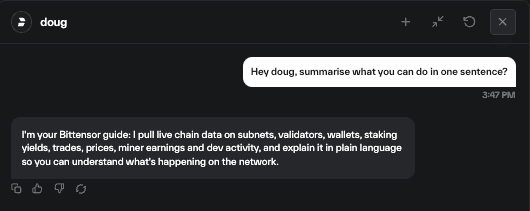
In his own words, doug is "your Bittensor guide." Ask him a question and he pulls current on-chain and market data, then explains the result in plain language. He can dig into subnets and markets, staking and validators, wallets and transactions, mining, and the taostats API.
He can also publish a shareable report with charts, built from the data he has fetched, like this example report. What he won't do matters just as much. Doug gives no financial advice, stays on Bittensor and closely related crypto topics, and shares data rather than hype. Between 500 and 1,000 people use him each month, with 30–45 a day, counted as distinct anonymous visitors.
From one GPT-5.2 call to an agent that checks the chain
Doug launched on taostats.io in May 2025. The first version was simple: a question went in, one call went to OpenAI's GPT-5.2, and an answer came back.
That works for definitions, but not for anything happening right now. "Who's been selling this subnet?" has a different answer every few minutes, and on a block explorer, where people are checking positions with their own money on the line, a confident guess is worse than no answer at all.
So taostats rebuilt doug as an agent. Instead of answering in one shot, he now decides what he needs to know, looks it up on the chain, and only then writes a reply. A typical question now uses about 2.4 model calls and 3.3 live data lookups across subnets, validators, wallets and the chain itself.
Why taostats chose SayGM for doug's model layer
An agent leans on its model layer far harder than a chatbot does. More calls per question means more chances for one of them to fail, and a single failed call can sink the whole answer. It also means more tokens, so pricing matters on every request rather than once per question.
When doug moved to Anthropic's models in early September, he moved through SayGM rather than to a direct account. SayGM is an LLM gateway: one API key for Claude, GPT, Gemini and a curated set of open-weight models, with prices below the model maker's list pricing. Inference providers compete to serve each model, and the best eligible bid sets the rate, capped at list. It speaks Anthropic's native Messages API, so doug's code could use Claude exactly as Anthropic documents it.
"Most crypto AI is a chatbot guessing from last year's data. Useless when it's your stake on the line. Doug checks the chain before he opens his mouth, and that only works if the model layer doesn't flake. SayGM gives us the models we need, a fallback on one key, and it costs much less than going direct." — mog, CEO & Founder of Taostats
The single key mattered as much as the price. Doug doesn't use one model; he uses three, each for a different job. Running them through one gateway means one bill, one integration and one place to swap a model when something better ships, which already happened once when doug moved from Claude Opus 5 to Opus 5.5 at the end of September.
Three models on one key: how an answer gets built
Every question doug answers touches up to three models, all routed through SayGM. The user asks doug something, and Claude Opus 5.5 works out which data it needs. While it fetches subnet, validator or wallet data from the chain, glm-5.3-flash writes the short status lines that tell the user what's happening, so nobody stares at a blank box. Opus then reads the results, sometimes asks for more, and writes the final answer.
If any primary call errors along the way, the request falls back to gpt-6-luna and the user still gets an answer. In its first few weeks of use, that failover path quietly covered 25 calls that would otherwise have ended in an error message.
That's doug's setup today, not a permanent lineup. New models ship every few weeks, and taostats will keep swapping in whichever ones do each job best. On SayGM, that's a change of model ID rather than a new integration, so the models behind doug can keep moving as fast as the field does.
On privacy: SayGM's gateway runs inside an Intel TDX trusted execution environment, so SayGM's operators and the host machine can't read doug's prompts. Because Claude, GLM Flash and GPT are standard models here, each model provider still receives the request under its own API terms, exactly as if doug called it directly. SayGM's private inference page explains where that line sits.
Cost savings against Anthropic list price
So far, doug's usage on SayGM has cost approximately 12% less than the same tokens would at Anthropic's public list prices.
Most of those tokens are the cheap kind. About 69% of doug's prompt tokens are cache reads: the instructions and tool definitions he re-sends on every call, which Anthropic bills at a fraction of the normal input rate. SayGM's sticky routing keeps each conversation on the same provider so that cache stays warm between calls, and cache reads are billed below list like every other token. LLM routing on SayGM covers how those routing choices are made.
The discount lands on every call doug makes, and as his usage grows, the same discount covers more tokens, so the savings grow with him. SayGM's rates are set per model by inference providers competing to serve each request, and as more providers join that marketplace, it's built to keep steady pressure on prices. Current rates for every model are on the SayGM pricing page.
Failed calls fell from 1.29% to 0.085%
The biggest change wasn't the price. Before the switch, 1.29% of doug's model calls failed. After it, 0.085% did, roughly fifteen times fewer.
For a single-call chatbot, a 1% failure rate is an occasional annoyance. For an agent making several calls per question, small per-call failure rates stack up into broken answers. SayGM's routing retries a request on another provider if one fails, and doug's own fallback to gpt-6-luna sits behind that, so a provider having a bad hour rarely reaches the user.
"One in a hundred calls used to fail. Now it's fewer than one in a thousand. When people are asking about real money, 'something went wrong' doesn't cut it. Better reliability and a smaller bill - switching to SayGM was the easiest call we made all year." — mog, CEO & Founder of Taostats
Common questions about AI agent infrastructure
What is AI agent infrastructure?
AI agent infrastructure is everything an agent needs beyond the model itself to do real work: access to one or more models, tools and data sources to call, routing and failover when a provider errors, caching to control costs, and logging to see what happened. SayGM covers the model layer: one API key for Claude, GPT, Gemini and open-weight models, with automatic retries across providers and prices below each model maker's list price.
How do you make an AI agent reliable in production?
Start by assuming individual model calls will sometimes fail. Route through an LLM provider or gateway that retries on another provider, add a fallback model for when the primary errors, and keep each step of the agent small enough to retry. SayGM retries a failed request on another provider automatically, and cascades let you set a backup model that takes over if the primary errors, all from one API key.
What is a crypto AI agent?
A crypto AI agent is an AI assistant that can look up live blockchain data, such as prices, wallets, staking positions and transactions, and explain it, instead of answering from training data alone. Because these agents make several model calls per answer, they need a model layer that stays up and stays affordable. SayGM gives crypto AI agents Claude, GPT and open-weight models on one key, and accepts payment in card, USDC, TAO or SN28 alpha, including x402 payments for autonomous agents.
Final thoughts
Moving "doug", the taostats AI agent, from a single chat call to a full agent changed what taostats could offer: answers built from live chain data instead of a model's memory. Running his AI agent infrastructure on SayGM made the change practical, with one key for every model he needs, failover that keeps errors away from users, and a lower bill than going direct. As doug handles more questions and newer models arrive, that foundation stays the same.
If you're building an agent and want Claude, GPT, open-weight models and failover on one key, priced below list, get a SayGM API key and point your existing code at it. To see doug at work, ask him something on taostats.
About taostats
Taostats is the block explorer and data analytics platform for Bittensor. It provides real-time and historical data on every subnet, validator, miner, block, account and transfer, alongside tools to stake, swap and move TAO, track a portfolio across wallets and export tax reports. Taostats is available on the web, as a free iOS and Android app and as a non-custodial browser wallet. Staking, swapping and transferring TAO through taostats comes with zero fees. For developers, taostats offers the leading Bittensor API, and taostats Pro adds higher limits and advanced tools for active holders, power users and teams.
Website | X | Discord | taostats Pro | Blog | Medium
About SayGM
SayGM is a drop-in inference gateway for teams who don't want to just take a company's word that their prompts are private. Every request is routed through a hardware-verified confidential environment - not even SayGM can see what's inside it. That's not a policy, it's provable. Swap in your existing OpenAI, Anthropic, or Gemini code and you're covered in minutes, at transparent, published rates with no hidden markup.
Say gm to AI at saygm.com.
Website | Twitter | Discord | Blog | Medium | Docs | LinkedIn
- AI Agent
- Bittensor
- Case Study
- Inference
BS