NEAR AI's Confidential Models, Now on SayGm
SayGm now routes requests to NEAR AI Cloud, bringing DeepSeek, GLM, Kimi, and Qwen into the same gateway that already reaches Claude, GPT, and Gemini. Here's what NEAR AI's confidential compute actually guarantees, and why it's a notable addition to SayGm's confidential tier.
BSBrittany Seales· Marketing5 min read
On this page
SayGm now routes requests to NEAR AI Cloud, adding NEAR AI's catalog of open-weight models, including DeepSeek, GLM, Kimi, and Qwen, to the same gateway that already reaches Claude, GPT, and Gemini. The addition comes as more model providers experiment with running inference inside hardware-secured enclaves instead of asking developers to trust a privacy policy, which is exactly the kind of infrastructure SayGm was built to sit in front of.
This post covers what NEAR AI's confidential compute actually guarantees, how a NEAR AI request is classified once it's inside SayGm's model catalog, and why that distinction matters if you're describing this route's privacy properties to your own users. If you haven't used SayGm before, the quickstart covers getting an API key and making your first request.
Table of Contents
- What Is NEAR AI Cloud?
- How SayGm Routes NEAR AI API Requests
- Why NEAR AI Is a Notable Confidential-Tier Provider
- Which NEAR AI Models Are Available
- Why Route Through SayGm Instead of NEAR AI Directly?
- Common Questions
- Get Started
What Is NEAR AI Cloud?
NEAR AI Cloud is a confidential-inference platform built by NEAR AI. It runs open-weight models, including DeepSeek, GLM, Kimi, and Qwen variants, inside Intel TDX combined with NVIDIA confidential-GPU enclaves, and issues a cryptographic attestation quote on every request that verifies which model and code actually ran. The API is OpenAI-compatible, so switching to it (or, in this case, having SayGm switch to it on your behalf) doesn't require a new SDK.
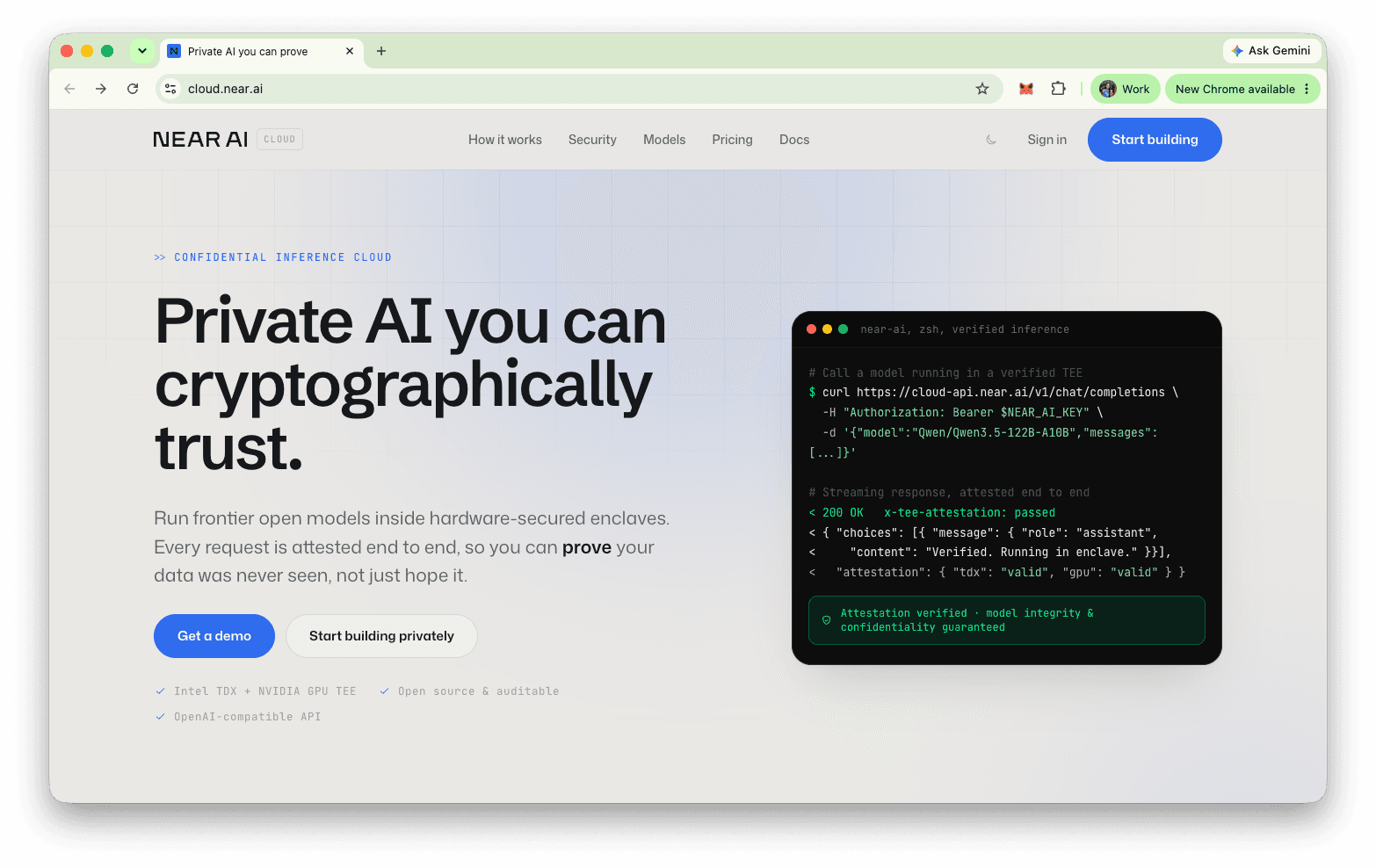
That combination of open models plus hardware attestation plus a familiar API, is a specific and fairly rare stack. It's also the reason NEAR AI is worth naming directly here rather than folding it into a generic "we support more open models now" line: most upstream providers in SayGm's catalog run standard cloud infrastructure, and NEAR AI is one of the few that's independently building the same kind of provable-privacy story SayGm is.
How SayGm Routes NEAR AI API Requests
SayGm's model catalog tags every model with a tier: frontier, confidential, or open. Here's a brief overview of the three tiers:
- Frontier: closed-weight models like GPT or Gemini, routed to their maker's own infrastructure under that maker's terms.
- Confidential: open-weight models where inference stays inside a trusted execution environment through completion, rather than being handed to a third party (like Frontier models).
- Open: open-weight models too, but served by a provider that isn't running a TEE. So the model itself is public, the same as Confidential, but the request is handled like a Frontier one.
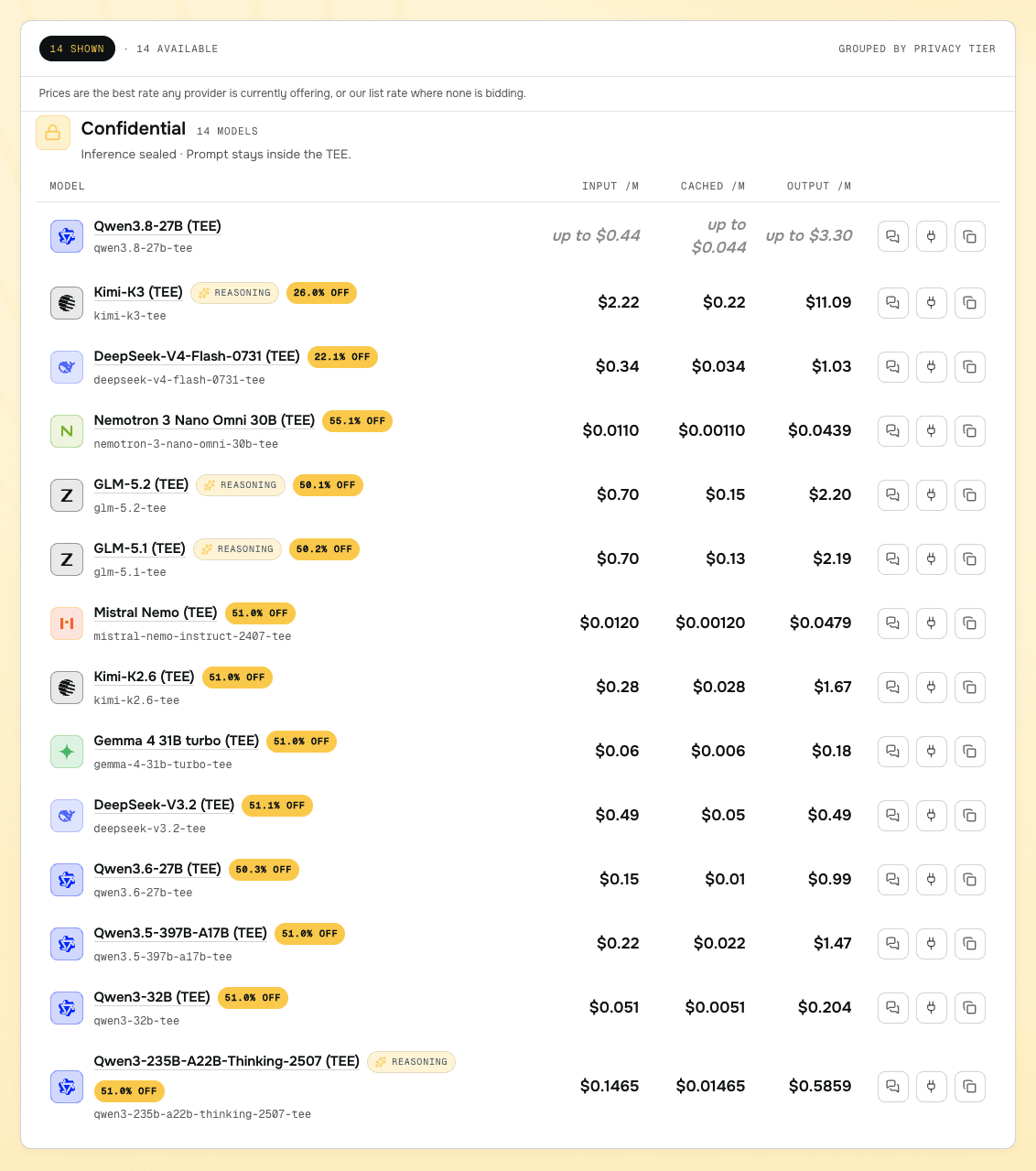
Models routed to NEAR AI sit in SayGm's confidential tier. That's the tier reserved for open-weight models where inference stays inside a trusted execution environment through completion, rather than being handed off to a third party under that party's own terms. It's the same guarantee SayGm gives its other confidential-tier models, not a special case built for NEAR AI specifically. See SayGm's privacy model for the full breakdown of what each tier means.
Why NEAR AI Is a Notable Confidential-Tier Provider
NEAR AI's models on SayGm carry the confidential tier, and we'll explain why they fall into this category. SayGm's documentation notes that a confidential-tier model is served through a confidential-compute provider, distinct from the model's original maker. NEAR AI Cloud is one of those providers. It runs its own hardware-based security, Intel TDX chips paired with NVIDIA's confidential-GPU technology, and verifies every request with its own attestation.
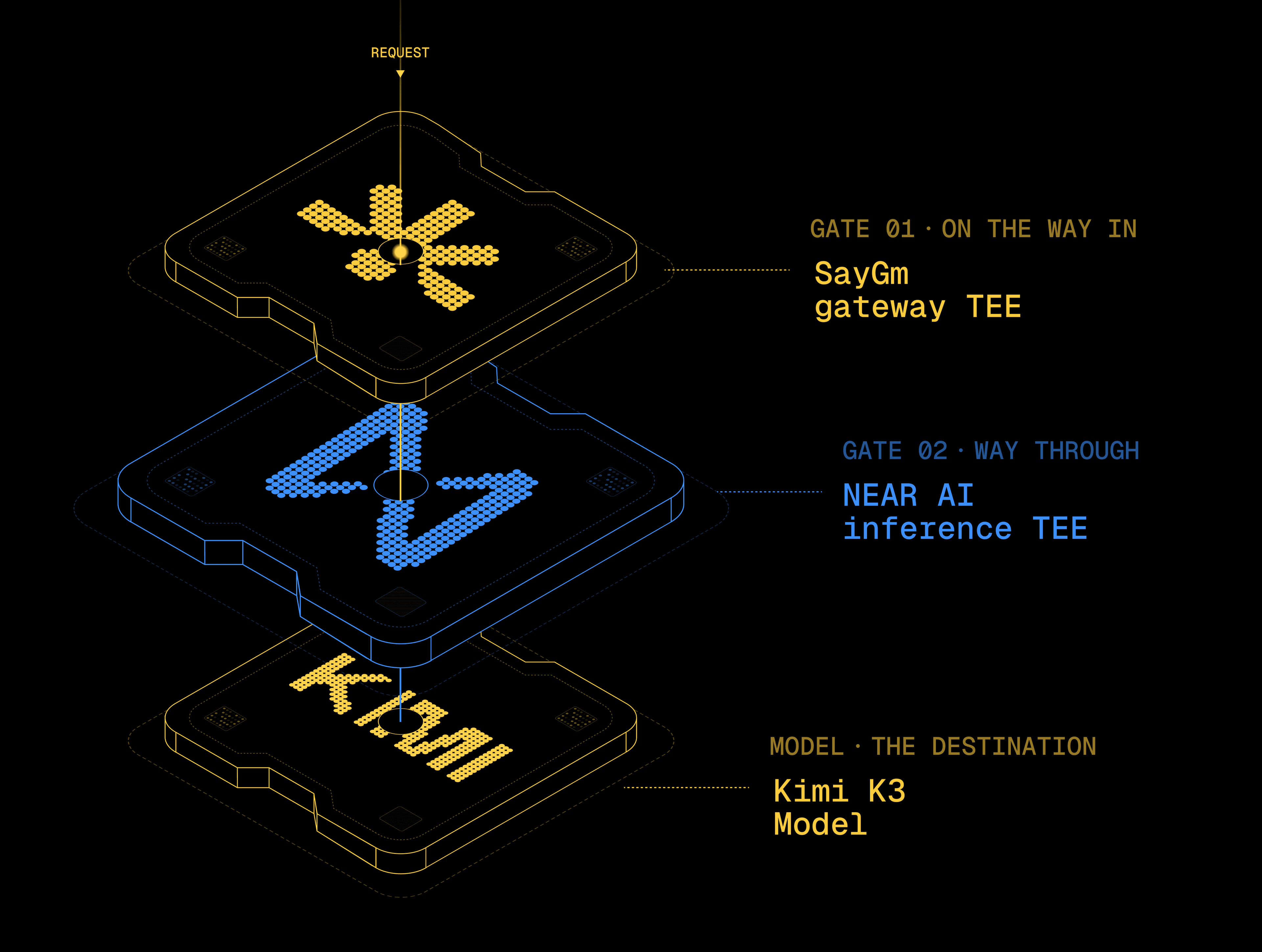
So a request to a NEAR AI-backed model routed through SayGm actually crosses two separately verifiable trusted execution environments: SayGm's gateway TEE on the way in, and NEAR AI's own inference TEE on the way through. That's not two claims blended into one bigger-sounding statement, it's the confidential-tier guarantee working as designed: the tier only earns its name because the infrastructure handling inference is itself attested (both NEAR AI as the model provider and SayGm as the gateway).
Which NEAR AI Models Are Available
As of this writing, NEAR AI Cloud's catalog includes open-weight models such as:
- DeepSeek V4 Flash and DeepSeek V4.1 Flash
- GLM 5.3 Flash
- Kimi K2.6 and Kimi K3
- Several Qwen 3.x variants, including a vision-language model
SayGm's pricing model is prepaid credit with no subscription and no platform markup on top of what the upstream provider charges, the same terms that apply to every other model in our catalog.
Why Route Through SayGm Instead of NEAR AI Directly?
NEAR AI Cloud's API is already OpenAI-compatible on its own, so the case for going through SayGm instead isn't about compatibility for this one provider specifically. It's about not having to choose. The same base URL and API key that reach NEAR AI's models also reach Claude, GPT, Gemini, and every other provider in SayGm's catalog, so a NEAR AI model can sit next to a frontier model in the same application without a second account, a second key, or a second SDK. If any provider has an outage or a model gets deprecated, that's also a routing problem SayGm's cascade and fusion modes are built to absorb, rather than an integration you have to rebuild on short notice.
Common Questions
Can SayGm see what I send to NEAR AI?
No. Once a request leaves SayGm's gateway TEE for NEAR AI, NEAR AI processes it under its own terms, the same as it would if you called NEAR AI directly. SayGm's TEE protects the trip between your application and the gateway, including your routing credentials; it doesn't extend to NEAR AI's own handling of the request afterward.
What is a trusted execution environment (TEE)?
A trusted execution environment, or TEE, is a hardware-isolated part of a chip that encrypts code and data while they're actively running, not just at rest or in transit. It's sometimes called a secure enclave, and it's the mechanism behind both SayGm's gateway and NEAR AI's own confidential compute, just applied at two different points in the request.
Is NEAR AI's API OpenAI-compatible?
Yes. NEAR AI Cloud exposes an OpenAI-compatible API on its own, which is part of why it fits cleanly into SayGm's gateway: the same request format works whether the model behind it is NEAR AI's, OpenAI's, or anyone else's in the catalog.
Get Started
To use SayGm's confidential tier, create an API key, pull the current catalog from GET /v1/models, and pick any model tagged confidential. From there it's the same OpenAI-compatible request format you'd use for any other model in the catalog. This tier keeps your prompt inside a trusted execution environment through inference, so it's never handed to a third party under separate terms. If you're describing this route's privacy properties to your own users or a security reviewer, tier is the field to check.
About SayGm
SayGm is a drop-in inference gateway for teams who don't want to just take a company's word that their prompts are private. Every request is routed through a hardware-verified confidential environment - not even SayGm can see what's inside it. That's not a policy, it's provable. Swap in your existing OpenAI, Anthropic, or Gemini code and you're covered in minutes, at transparent, published rates with no hidden markup.
Say gm to AI at saygm.com.
- Inference
- Near
- Partnership
- Privacy
BS