Claude API Pricing 2026: Opus, Sonnet and Haiku Costs
Claude Sonnet 5.5 costs $2 per million input tokens and $10 output on Anthropic's price list. Here's what every Claude model costs, what caching and batch save, what three real workloads cost a month, and how to buy the same models for less.
DDaniel· Builder5 min read
On this page
Prices checked 17 November 2026. As of 17 November 2026, Claude Sonnet 5.5 costs $2 per million input tokens and $10 output on Anthropic's price list, and $1.03 and $5.15 on SayGM. Every Claude model is 48.5% cheaper on SayGM, from Haiku 5.5 at $0.0515 to Opus 5.5 at $2.06, with no subscription and no fee on buying credit. Amazon Bedrock, Google Cloud, Microsoft Foundry, OpenRouter and Requesty all charge Anthropic's list price or more. Point the Anthropic SDK at SayGM and your code runs as before; Anthropic still receives the prompt, but not who sent it.
Claude API pricing, checked 17 November 2026 (per million tokens)
| Model | Provider | Input per M | Output per M | Cache read per M | Batch (in / out) | Checked |
|---|---|---|---|---|---|---|
| Claude Opus 5.5 | SayGM | $2.06 | $10.30 | $0.103 | Not offered | 17 Nov 2026 |
| Anthropic | $4.00 | $20.00 | $0.20 | $2.00 / $10.00 | 17 Nov 2026 | |
| Claude Sonnet 5.5 | SayGM | $1.03 | $5.15 | $0.0515 | Not offered | 17 Nov 2026 |
| Anthropic | $2.00 | $10.00 | $0.10 | $1.00 / $5.00 | 17 Nov 2026 | |
| Claude Haiku 5.5 | SayGM | $0.0515 | $0.2575 | $0.00515 | Not offered | 17 Nov 2026 |
| Anthropic | $0.10 | $0.50 | $0.01 | $0.05 / $0.25 | 17 Nov 2026 | |
| Claude Fable 5.2 | SayGM | $4.12 | $20.60 | $0.103 | Not offered | 17 Nov 2026 |
| Anthropic | $8.00 | $40.00 | $0.20 | $4.00 / $20.00 | 17 Nov 2026 |
List prices before tax, checked 17 November 2026. Anthropic's figures are from its pricing page; SayGM's are from its live API (api.saygm.com/v1/models) and match the model pages. Haiku 5.5 rates are for prompts up to 100,000 tokens.
Table of Contents
- How does Claude API pricing work?
- Claude pricing by model
- Prompt caching and batch: Anthropic's own discounts
- What the Claude API really costs: three worked examples
- Claude subscriptions vs the API
- Where to buy Claude: SayGM vs Anthropic vs Bedrock vs Google Cloud vs OpenRouter
- How can you pay less for the Claude API?
- Claude API pricing FAQ
- TL;DR
- About SayGM
How does Claude API pricing work?
The Claude API bills per token, at separate rates for input and output, with no monthly fee. Anthropic API pricing is one published list for every model, and as of 17 November 2026 every current Claude model charges five times as much for output as for input. Output costs more because the model generates it one token at a time, while input is read in a single pass.
A Claude bill has six parts:
- Input tokens. Your prompt, system prompt, documents, tool definitions and conversation history, charged at the base input rate.
- Output tokens. What Claude writes back, including its reasoning, at five times the input rate.
- Cache writes. The first time you cache a prompt prefix, it costs 1.25 times the input rate for a 5-minute cache or 2 times for a 1-hour cache.
- Cache reads. Every later request that reuses the prefix pays a fraction of the input rate: 5% on Opus 5.5 and Sonnet 5.5, 2.5% on Fable 5.2, and 10% on Haiku 5.5 and older models.
- Batch. Requests sent through the Batch API cost half the standard rate on both input and output, and the discount stacks with caching.
- Tools. Web search costs $10 per 1,000 searches on top of tokens. Code execution is free alongside web search or web fetch; on its own, each organisation gets 1,550 free hours a month and then pays $0.05 an hour per container. Web fetch has no extra charge.
Three modifiers can push the bill above the list. Haiku 5.5 charges more for prompts over 100,000 tokens ($0.50 and $2.50); every other current model includes its full 1M-token context at the standard rate. Fast mode on Opus 5.5 doubles the price to $8 and $40 for up to 2.5 times faster output. And US-only inference, set with the inference_geo parameter, adds 10% to every line.
One more thing to know before comparing models: Claude 4.7 and later use a newer tokenizer that, per Anthropic, produces about 30% more tokens for the same text. A newer model at the same per-token rate can cost a little more for the same prompt.
Claude pricing by model
Claude Opus pricing
Claude Opus 5.5 costs $4 per million input tokens and $20 output on Anthropic, as of 17 November 2026, with cache reads at $0.20. On SayGM it's $2.06 and $10.30, with cache reads at $0.103. Opus is Anthropic's model for long-running agentic coding and knowledge work, and it's the one to pay for when a wrong answer costs more than the tokens.
Opus 5.5 is cheaper than the Opus models before it. Opus 5, 4.8, 4.7, 4.6 and 4.5 are all still listed at $5 and $25, and Opus 4.1 and Opus 4 at $15 and $75. On SayGM, Opus 5, 4.8 and 4.7 are $2.575 and $12.875. There's no price reason to stay on an older Opus.
Claude Sonnet pricing
Claude Sonnet 5.5 costs $2 per million input tokens and $10 output on Anthropic, as of 17 November 2026, with cache reads at $0.10. On SayGM it's $1.03 and $5.15, with cache reads at $0.0515. Anthropic calls it the best combination of speed and intelligence, and it's the default for most production work: RAG, support, coding assistants and agents that don't need Opus.
Sonnet 5 is the same price as Sonnet 5.5, but its cache reads cost twice as much ($0.20), so cache-heavy workloads should move. Sonnet 4.6, 4.5 and 4 are still listed at $3 and $15. On SayGM, Sonnet 5 is $1.03 and $5.15 and Sonnet 4.6 is $1.545 and $7.725.
Claude Haiku pricing
Claude Haiku 5.5 costs $0.10 per million input tokens and $0.50 output on Anthropic, as of 17 November 2026, for prompts up to 100,000 tokens, and $0.50 and $2.50 above that. On SayGM it's $0.0515 and $0.2575, and $0.2575 and $1.2875 over 100,000 tokens. Haiku is built for high-volume, latency-sensitive work: classification, extraction, routing and short replies.
Haiku 5.5 is a tenth of the price of Haiku 4.5, which is still listed at $1 and $5. On SayGM, Haiku 4.5 is $0.515 and $2.575. Unless you've validated against 4.5 and can't move, Haiku 5.5 is the one to use.
Claude Fable 5.2
Claude Fable 5.2 is built for demanding reasoning and long-horizon agentic work, at $8 and $40 on Anthropic and $4.12 and $20.60 on SayGM. It shares the top price on Anthropic's list with Claude Mythos 5.2, which SayGM doesn't carry. Its cache reads are $0.20, a 97.5% discount on fresh input. Our Claude Fable 5.2 pricing guide covers it in full.
Prompt caching and batch: Anthropic's own discounts
Anthropic's two discounts are the first place to cut a Claude bill, and they stack with each other.
Prompt caching stores a prompt prefix, such as a long system prompt, a document or a codebase, so later requests read it at a fraction of the input price. A 5-minute cache costs 1.25 times the input rate to write and pays for itself after one read; a 1-hour cache costs twice the input rate and pays for itself after two. On Sonnet 5.5, a 100,000-token system prompt costs $0.20 per request fresh and $0.01 as a cache read. Over 1,000 requests, that's $200 against about $10, plus a $0.25 write each time the cache is refreshed. You can turn on automatic caching with one cache_control field, per Anthropic's prompt caching docs.
The Batch API processes requests asynchronously at 50% off input and output. It suits work nobody is waiting on: evaluations, document backfills, nightly classification and report generation. Sonnet 5.5 drops to $1 and $5, and with caching on top, cache reads drop to $0.05. Details are in Anthropic's batch processing docs.
Caching applies whenever requests share a prefix, real-time or not. Batch applies only when the answer can wait: Anthropic says most batches finish within an hour, and any that haven't finished within 24 hours expire.
What the Claude API really costs: three worked examples
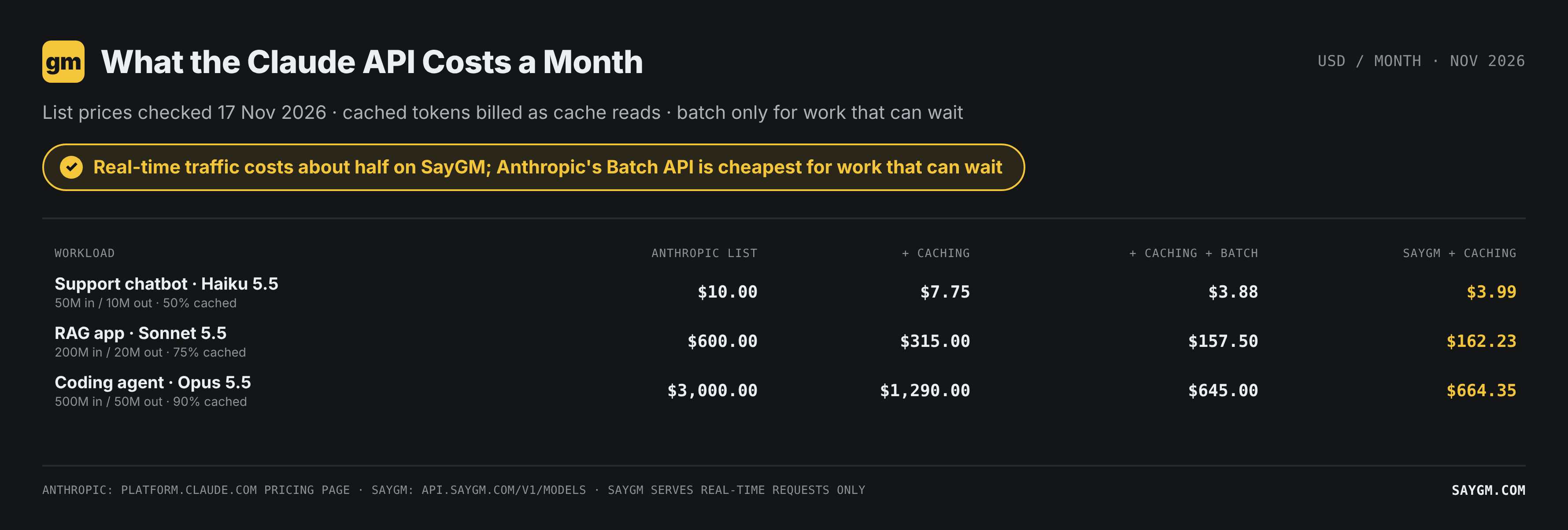
Here's what three common workloads cost a month at list prices on 17 November 2026. In each, cached tokens are billed as cache reads; cache writes are left out because they're a small share once a prefix is reused many times. The batch column only applies if the work can wait.
| Workload | Anthropic list | Anthropic + caching | Anthropic + caching + batch | SayGM + caching |
|---|---|---|---|---|
| Support chatbot, Haiku 5.5 | $10.00 | $7.75 | $3.88 | $3.99 |
| RAG app, Sonnet 5.5 | $600.00 | $315.00 | $157.50 | $162.23 |
| Coding or research agent, Opus 5.5 | $3,000.00 | $1,290.00 | $645.00 | $664.35 |
Support chatbot on Haiku 5.5. 50 million input tokens and 10 million output a month, half the input cached, every prompt under 100,000 tokens. At list price, that's $5 of input and $5 of output, $10 in total. Caching half the input cuts it to $7.75. On SayGM with the same caching, it's $3.99. At this volume Haiku 5.5 is cheap on any route, which is the point of it.
RAG app on Sonnet 5.5. 200 million input tokens and 20 million output, with a large system prompt and retrieved context making 75% of the input cache reads. At list price, that's $400 of input and $200 of output, $600. With caching, 50 million fresh tokens cost $100 and 150 million cache reads cost $15, so the bill is $315. On SayGM with caching, it's $162.23.
Coding or research agent on Opus 5.5. 500 million input tokens and 50 million output, with 90% of the input cache reads, which is typical for an agent that resends the same files and instructions every turn. At list price, that's $2,000 of input and $1,000 of output, $3,000. With caching, 50 million fresh tokens cost $200 and 450 million cache reads cost $90, so the bill is $1,290, of which $1,000 is output. On SayGM with caching, it's $664.35.
Two patterns come out of these numbers. Once caching is on, output is most of the bill, so capping output length saves more than trimming prompts. And for real-time traffic, SayGM is the cheapest route by about half; for work that can wait, Anthropic's Batch API with caching comes out slightly lower, because SayGM serves real-time requests only.
Claude subscriptions vs the API
Claude's Pro and Max plans are monthly subscriptions for people using Claude in the Claude apps and Claude Code. They don't include API access. The API is billed separately, per token, through the Claude Console, and that's what every price in this post covers. If you're choosing a plan for coding, our Claude Code pricing guide compares the subscriptions with paying per token.
Where to buy Claude: SayGM vs Anthropic vs Bedrock vs Google Cloud vs OpenRouter
Claude is a closed model, so every route ends at Anthropic's models. What changes is the price, the extras around it, and who sits in the path. Each cell shows input / output per million tokens, then the cost of 100 million tokens at an 80/20 input-to-output mix. All checked 17 November 2026.
| Model | SayGM | Anthropic direct | Bedrock, Google Cloud, Foundry (global / regional) | OpenRouter (+5.5% fee) | Requesty (+5% markup) |
|---|---|---|---|---|---|
| Claude Opus 5.5 | $2.06 / $10.30 · $371 | $4.00 / $20.00 · $720 | $4.00 / $20.00 · $720 / $792 | $4.22 / $21.10 · $760 | $4.20 / $21.00 · $756 |
| Claude Sonnet 5.5 | $1.03 / $5.15 · $185 | $2.00 / $10.00 · $360 | $2.00 / $10.00 · $360 / $396 | $2.11 / $10.55 · $380 | $2.10 / $10.50 · $378 |
| Claude Haiku 5.5 | $0.0515 / $0.2575 · $9.27 | $0.10 / $0.50 · $18 | $0.10 / $0.50 · $18 / $19.80 | $0.11 / $0.53 · $19 | $0.11 / $0.53 · $18.90 |
| Claude Fable 5.2 | $4.12 / $20.60 · $742 | $8.00 / $40.00 · $1,440 | $8.00 / $40.00 · $1,440 | $8.44 / $42.20 · $1,519 | $8.40 / $42.00 · $1,512 |
SayGM from its live API; Anthropic from its pricing page; the cloud rates from OpenRouter's and Requesty's endpoint listings, which match Anthropic's note that regional endpoints cost 10% more than global ones; OpenRouter and Requesty from their own model lists and pricing pages.
SayGM
$1.03 / $5.15 for Sonnet 5.5, 48.5% below Anthropic's list on every Claude model, with cache reads discounted by the same amount. Independent providers compete to serve each request and every token line is capped at list price. There's no subscription and no fee on funding your balance, and the same key serves GPT, Gemini and open-weight models. SayGM serves real-time requests only, so there's no batch discount.
Anthropic direct
$2 / $10. Buying direct gets you the full platform: the Batch API at 50% off, fast mode, US-only inference at a 10% premium, and data terms in your own name, such as zero data retention for eligible models. You pay the list rate for real-time traffic.
Amazon Bedrock, Google Cloud and Microsoft Foundry
$2 / $10 on global endpoints and $2.20 / $11 on regional ones. The clouds suit teams that want Claude billed and governed alongside the rest of their cloud spend, under an existing agreement. Anthropic also runs Claude Platform on AWS, billed through AWS Marketplace at its standard rates.
OpenRouter
$2.11 / $10.55 once its 5.5% fee on credit is added. OpenRouter routes across Anthropic and the three clouds, fails over when one endpoint errors, and lists batch variants of each Claude model at half price. We compare it with other gateways in our OpenRouter alternatives breakdown.
Requesty
$2.10 / $10.50 with its 5% markup on model cost. Requesty also routes across Anthropic, Bedrock and Google Cloud, including EU regional endpoints.
How can you pay less for the Claude API?
- Pick the smallest model that does the job. Haiku 5.5 is a twentieth of Sonnet 5.5's price, and Sonnet 5.5 is half of Opus 5.5's. Route the easy steps of a workload, such as classification, extraction and routing, to Haiku and keep Opus for the hard ones.
- Cache long prompts. On Sonnet 5.5 and Opus 5.5, a cache read is 5% of the input rate. Put stable content first in the prompt so it can be cached.
- Batch work that can wait. The Batch API takes 50% off, and stacks with caching.
- Cap output length. Output is five times the input rate and, with caching on, most of the bill. Set
max_tokensand ask for shorter answers where you can. - Move off older models. Opus 5 costs more than Opus 5.5, and Haiku 4.5 costs ten times Haiku 5.5.
- Route real-time traffic through SayGM. It's 48.5% below Anthropic's list on every Claude model, cache reads included, with no subscription or credit fee. The route comparison above has the numbers.
Switching keeps your code. SayGM serves Claude through the Anthropic Messages API, so the Anthropic SDK works with a new base URL and key:
import os
from anthropic import Anthropic

client = Anthropic(
    base_url="https://api.saygm.com",
    api_key=os.environ["SAYGM_API_KEY"],
)

message = client.messages.create(
    model="claude-sonnet-5-5",
    max_tokens=1024,
    messages=[{"role": "user", "content": "Summarise this support ticket in two sentences."}],
)
print(message.content[0].text)
What SayGM doesn't change is who runs the model. On a Claude model, Anthropic still receives the prompt and processes it under the serving provider's API terms. SayGM routes the request anonymously, so Anthropic gets the prompt but not who sent it, and the gateway in between runs inside an Intel TDX enclave that its own operators can't read, with attestation anyone can verify. That's different from SayGM's sealed open-weight routes, where the prompt stays sealed end to end. For more on where the line sits, see is Claude private.
Plenty of teams run both: real-time traffic through SayGM, and batch jobs or workloads that need data terms in their own name direct with Anthropic. SayGM vs Anthropic sets out the trade-offs line by line, and the same key covers GPT (see OpenAI API pricing) and open-weight models, compared in our cheapest LLM API guide.
Claude API pricing FAQ
How much does the Claude API cost?
As of 17 November 2026, the Claude API costs from $0.10 per million input tokens and $0.50 output for Claude Haiku 5.5 to $8 and $40 for Claude Fable 5.2 and Claude Mythos 5.2, on Anthropic's price list. Claude Sonnet 5.5, the model most teams use, is $2 and $10. SayGM serves the same models 48.5% below those rates.
How much does Claude Opus 5.5 cost?
Claude Opus 5.5 costs $4 per million input tokens and $20 output on Anthropic, as of 17 November 2026, with cache reads at $0.20 and batch at $2 and $10. On SayGM it's $2.06 and $10.30.
How much does Claude Sonnet 5.5 cost?
Claude Sonnet 5.5 costs $2 per million input tokens and $10 output on Anthropic, as of 17 November 2026, with cache reads at $0.10 and batch at $1 and $5. On SayGM it's $1.03 and $5.15.
What is the cheapest Claude model?
Claude Haiku 5.5 is the cheapest Claude model, at $0.10 per million input tokens and $0.50 output on Anthropic as of 17 November 2026, for prompts up to 100,000 tokens. On SayGM it's $0.0515 and $0.2575, so a million input tokens costs about five cents.
Is the Claude API free?
No. As of 17 November 2026, Anthropic has no free tier for the Claude API, but new users receive free credits to test it, per its pricing page. After that, every request is billed per token.
Is the Claude API included in Claude Pro?
No. Claude Pro and Max are subscriptions for the Claude apps and Claude Code, and the API is billed separately per token through the Claude Console, as of November 2026.
How do I pay less for the Claude API?
Use the smallest model that does the job, cache long prompts (cache reads are 5% of the input rate on Sonnet 5.5 and Opus 5.5), batch work that can wait for 50% off, and cap output length. For real-time traffic, SayGM serves every Claude model 48.5% below Anthropic's list as of 17 November 2026, with no subscription or credit fee.
Is Claude cheaper on AWS Bedrock or OpenRouter?
No. As of 17 November 2026, Amazon Bedrock charges Anthropic's list price for Claude on global endpoints and 10% more on regional ones, and OpenRouter adds a 5.5% fee on credit, so Sonnet 5.5 is $2.11 and $10.55 there. SayGM is $1.03 and $5.15.
Does Anthropic see my prompts if I use Claude through SayGM?
Yes. Anthropic runs Claude, so it receives the prompt on every route, including SayGM. SayGM routes requests anonymously, so Anthropic gets the prompt but not who sent it, and the SayGM gateway runs in an Intel TDX enclave its operators can't read. Only SayGM's confidential open-weight models keep the prompt sealed end to end.
TL;DR
On Claude API pricing as of 17 November 2026, Sonnet 5.5 costs $2 per million input tokens and $10 output on Anthropic's list, Haiku 5.5 is $0.10 and $0.50, and Opus 5.5 is $4 and $20. Caching cuts repeated input by 90% to 97.5%, and batch halves work that can wait. SayGM serves the same Claude models 48.5% below list for real-time traffic, with no subscription or credit fee, while Bedrock, Google Cloud, OpenRouter and Requesty charge list or more. Anthropic still receives the prompt either way.
Point the Anthropic SDK at api.saygm.com, set the model to claude-sonnet-5-5, and say gm to AI.
About SayGM
SayGM is a drop-in inference gateway for teams who don't want to just take a company's word that their prompts are private. Route to a confidential model and your prompt is sealed inside hardware-verified execution, where not even SayGM can see it. That's not a policy, it's provable. Swap in your existing OpenAI, Anthropic, or Gemini code and you're covered in minutes, at transparent, published rates with no hidden markup.
Say gm to AI at saygm.com.
- claude api pricing
D
DanielBuilder
Helping to build and grow SayGM. Obsessed with technology & AI, especially local, private models, and TinyML